Packaging Machinery Market to Hit $121.86 Billion by 2035, Up from $69.42 Billion in 2025
NEW YORK, NY, UNITED STATES, September 15, 2026 /EINPresswire.com/ -- The global packaging machinery market is
Press Release Disclaimer: This is a press release distributed through the XPR Media network. It has not been independently verified by our newsroom.
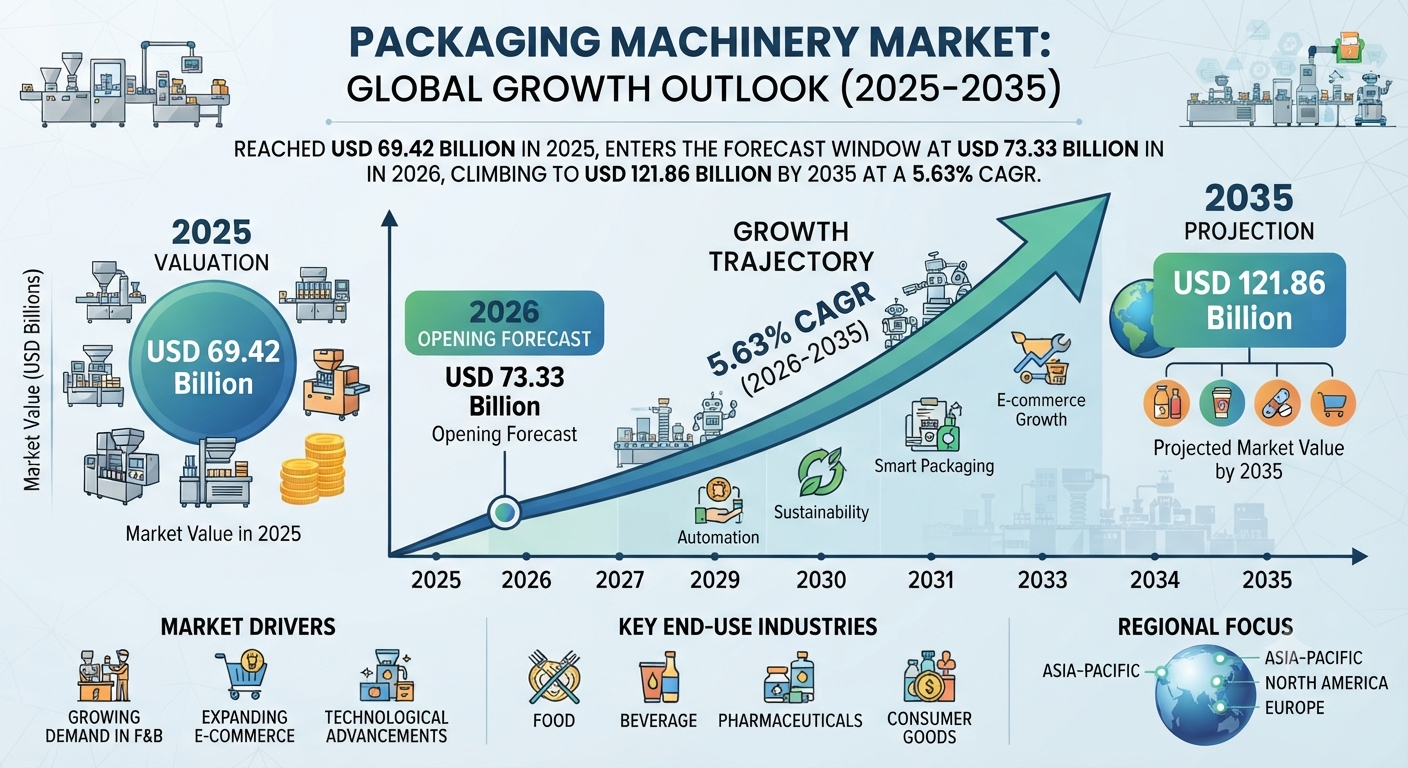

NEW YORK, NY, UNITED STATES, September 15, 2026 /EINPresswire.com/ — The global packaging machinery market is undergoing significant transformation as manufacturers across food, beverages, pharmaceuticals, personal care, chemicals, and other industries invest in faster, smarter, and more sustainable packaging systems. Rising demand for packaged products, increasing automation, labor shortages, sustainability requirements, and the rapid growth of e-commerce are creating new opportunities for machinery manufacturers.
According to the latest Market Research Future (MRFR) analysis, the global packaging machinery market reached USD 69.42 billion in 2025 and is projected to increase from USD 73.33 billion in 2026 to USD 121.86 billion by 2035, representing a 5.63% CAGR during 2026–2035.
What Is Packaging Machinery?
Packaging machinery includes equipment used to fill, seal, label, wrap, carton, bottle, palletize, and otherwise prepare products for storage, transportation, and sale.
The market encompasses several types of equipment, including:
Filling and dosing machines
Labeling machines
Form-fill-seal equipment
Cartoning machinery
Wrapping machinery
Palletizing and depalletizing systems
Bottling lines
Other specialized packaging equipment
Modern packaging lines are increasingly connected and automated. Sensors, robotics, machine vision, artificial intelligence, and cloud-based monitoring are helping manufacturers improve productivity while reducing downtime and material waste.
Get Sample @ https://www.marketresearchfuture.com/sample_request/1199
Key Factors Driving Market Growth
Increasing Demand for Packaged Products
The growing consumption of packaged food, beverages, pharmaceuticals, cosmetics, and household products is one of the fundamental drivers of the packaging machinery industry.
Urbanization and changing lifestyles are increasing demand for convenient, portion-controlled, hygienic, and ready-to-use products. Manufacturers therefore require high-speed packaging systems capable of handling large production volumes while maintaining consistent quality.
The food industry remains the largest end-use sector, accounting for 27.4% of market revenue in 2025, according to MRFR.
Growing Automation and Robotics
Automation is rapidly changing packaging production. Manufacturers are replacing labor-intensive processes with robotic palletizers, automated case packers, vision inspection systems, and servo-controlled machines.
Fully automatic and robotics-integrated packaging lines accounted for 58.9% of market revenue in 2025.
Automation helps manufacturers:
Increase production speed
Reduce labor requirements
Improve packaging consistency
Minimize human error
Improve workplace safety
Reduce production downtime
Support rapid product changeovers
Labor shortages are particularly encouraging investment in automated end-of-line operations such as palletizing and case packing.
Sustainability Is Reshaping Packaging Machinery
Sustainability has become one of the most important influences on packaging machinery development.
Brand owners are increasingly moving toward recyclable, lightweight, paper-based, and fiber-based packaging. This transition requires machinery capable of processing new materials while maintaining production efficiency.
MRFR highlights packaging waste regulation and fiber substitution as major drivers of machinery investment. Equipment manufacturers are developing adaptive forming, feeding, sealing, folding, and gluing systems to accommodate changes in packaging materials.
Energy efficiency is another important consideration. Manufacturers are looking for machines that use less electricity, compressed air, water, and other resources without compromising production capacity.
The Role of Smart Packaging Machinery
Digital transformation is becoming an essential part of modern packaging operations.
Connected machines can collect production data and provide real-time information about:
Machine performance
Production speed
Material consumption
Downtime
Product quality
Maintenance requirements
Energy consumption
IoT-enabled machinery can also support predictive maintenance. Instead of waiting for equipment to fail, manufacturers can identify potential problems through sensor data and schedule maintenance before a major breakdown occurs.
This can improve equipment availability and reduce unplanned production interruptions.
Filling and Dosing Machinery Leads the Market
Filling and dosing equipment represents one of the most important categories in the packaging machinery industry.
MRFR estimates that filling and dosing machinery accounted for 21.6% of packaging machinery revenue in 2025. Its broad application across liquids, powders, pastes, food products, beverages, pharmaceuticals, and chemicals supports its leading position.
Filling systems are becoming increasingly sophisticated, with manufacturers integrating accurate dosing technologies, automated controls, inspection systems, and rapid changeover capabilities.
Cartoning Machinery Shows Strong Growth
Cartoning is another important area of opportunity. MRFR identifies cartoning as the fastest-expanding machine-type category, with an estimated 8.11% CAGR.
Growth is being supported by the transition toward fiber-based packaging and increased demand for secondary packaging associated with e-commerce.
Modern cartoning systems are being designed for greater flexibility, enabling manufacturers to handle multiple carton sizes and formats with minimal manual intervention.
Pharmaceutical Packaging Creates New Opportunities
Pharmaceutical packaging is becoming an increasingly important growth area for machinery manufacturers.
The pharmaceutical industry requires highly controlled packaging processes because products must meet strict requirements related to product protection, traceability, dosage accuracy, contamination prevention, and regulatory compliance.
MRFR projects the pharmaceutical end-use segment to grow at approximately 6.95% CAGR through 2035.
Demand is being supported by increasing pharmaceutical production, biologics, vaccines, personalized medicines, and more sophisticated drug-delivery systems.
Packaging equipment for pharmaceutical applications is increasingly incorporating automated inspection, serialization, environmental monitoring, and data recording.
E-Commerce and Packaging Machinery
The growth of e-commerce is changing packaging requirements across many industries.
Online retailers and fulfillment centers need packaging systems capable of processing a large number of products and package formats. This creates demand for automated filling, sealing, labeling, sorting, case packing, and palletizing technologies.
The growth of e-commerce also increases the importance of secondary and tertiary packaging designed to protect products during transportation.
Packaging machinery manufacturers that can provide flexible systems capable of handling changing product dimensions and high SKU volumes are likely to benefit from this trend.
Buy Now @ https://www.marketresearchfuture.com/checkout?currency=one_user-USD&report_id=1199
Regional Market Outlook
Asia-Pacific
Asia-Pacific represents the largest regional market, accounting for approximately 38.4% of global packaging machinery revenue in 2025.
China and India are important contributors because of their expanding food-processing industries, growing consumer markets, manufacturing investments, and increasing adoption of automated production systems.
The region’s growth is also supported by rising urbanization, e-commerce, and investment in pharmaceutical and consumer-goods manufacturing.
Europe
Europe remains a major market for packaging machinery, with sustainability and regulatory compliance playing a particularly important role.
Manufacturers are investing in machinery capable of processing recyclable and fiber-based materials while improving energy efficiency and reducing material consumption.
North America
North America is another significant market, supported by advanced manufacturing infrastructure and strong adoption of automation.
The region’s packaging machinery demand is being driven by food and beverage production, pharmaceuticals, consumer goods, e-commerce, and labor-saving technologies.
Middle East and Africa
The Middle East and Africa region represents an important emerging opportunity. MRFR expects the region to record the fastest regional CAGR of approximately 7.24% through 2035.
Investment in domestic food processing, beverages, pharmaceuticals, and manufacturing infrastructure is supporting demand for new packaging lines.
Major Challenges
Despite positive growth prospects, the packaging machinery industry faces several challenges.
High Capital Investment
Advanced automated packaging lines can require substantial capital expenditure. This can be particularly challenging for small and medium-sized manufacturers.
As a result, some businesses are choosing incremental upgrades, retrofits, or individual machine replacements instead of investing in complete production lines.
Skilled Labor Requirements
Although automation reduces the need for manual labor, modern packaging systems require skilled technicians who understand robotics, servo systems, machine vision, industrial networking, and software.
The shortage of qualified technical personnel can make it difficult for manufacturers to fully utilize advanced machinery.
Integration Challenges
Modern packaging lines often combine equipment from multiple suppliers. Integrating different machines, control systems, sensors, and data platforms can create technical and operational challenges.
Manufacturers increasingly prefer suppliers capable of providing complete integrated solutions and long-term technical support.
Read More @ https://www.marketresearchfuture.com/reports/packaging-machinery-market-1199
Opportunities for Packaging Machinery Manufacturers
The market provides several attractive opportunities for equipment manufacturers.
Retrofitting Existing Machinery
The installed base of packaging equipment creates a significant opportunity for retrofit solutions.
Sensors, connectivity modules, machine vision, servo systems, and energy-efficient components can be added to existing machines, allowing manufacturers to modernize their facilities without replacing complete production lines.
Predictive Maintenance
Connected equipment allows machinery manufacturers to move beyond one-time equipment sales and offer recurring monitoring and maintenance services.
Predictive maintenance solutions can help customers identify equipment problems before they cause costly production stoppages.
Sustainable Packaging Equipment
The shift toward paper, fiber, recyclable materials, and lightweight packaging is creating demand for machinery specifically designed to process new packaging formats.
Equipment manufacturers that develop flexible machines for sustainable packaging materials can gain a competitive advantage.
Robotics and AI
Robotics and artificial intelligence are likely to become increasingly important in packaging operations.
AI-powered vision systems can inspect products, detect defects, and verify packaging quality. Robots can perform picking, packing, palletizing, and other repetitive tasks with high accuracy.
Competitive Landscape
The global packaging machinery market includes several major companies, including Tetra Pak International S.A., Krones Inc., Coesia S.p.A., Robert Bosch GmbH, Graphic Packaging International, LLC, and ProMach, Inc.
Competition is increasingly focused on automation, machine flexibility, sustainability, software capabilities, energy efficiency, and after-sales service.
Rather than competing solely on machinery speed or price, leading companies are increasingly differentiating themselves through integrated production systems, digital monitoring, predictive maintenance, and lifecycle services.
Future Outlook
The future of packaging machinery will be defined by automation, connectivity, sustainability, flexibility, and intelligent manufacturing.
Packaging lines are expected to become increasingly autonomous, with machine vision and advanced control systems making real-time decisions about product quality and machine performance.
Connected equipment will also allow manufacturers to monitor production remotely and use data to improve throughput, reduce waste, and optimize maintenance schedules.
At the same time, sustainability requirements will continue influencing machine design. Machinery manufacturers will need to support new materials, lightweight packaging structures, recyclable formats, and more efficient production processes.
Browse More Reports:
Germany concrete cooling market https://www.marketresearchfuture.com/reports/germany-concrete-cooling-market-56203
3D Concrete Printing Market https://www.marketresearchfuture.com/reports/3d-concrete-printing-market-1992
Fiberglass Flooring Market https://www.marketresearchfuture.com/reports/fiberglass-flooring-market-2936
Concrete Cooling Market https://www.marketresearchfuture.com/reports/concrete-cooling-market-1950
Plumbing Fixtures and Fittings Market https://www.marketresearchfuture.com/reports/plumbing-fixtures-fittings-market-2399
Market Research Future
Market Research Future
+1 855-661-4441
email us here
Legal Disclaimer:
EIN Presswire provides this news content “as is” without warranty of any kind. We do not accept any responsibility or liability
for the accuracy, content, images, videos, licenses, completeness, legality, or reliability of the information contained in this
article. If you have any complaints or copyright issues related to this article, kindly contact the author above.

Media gallery