As School Phone Bans Expand, Student Access and Fair Discipline Must Remain Part of the Conversation
New research links strict phone restrictions to modest academic gains, while raising questions for families about
Press Release Disclaimer: This is a press release distributed through the XPR Media network. It has not been independently verified by our newsroom.
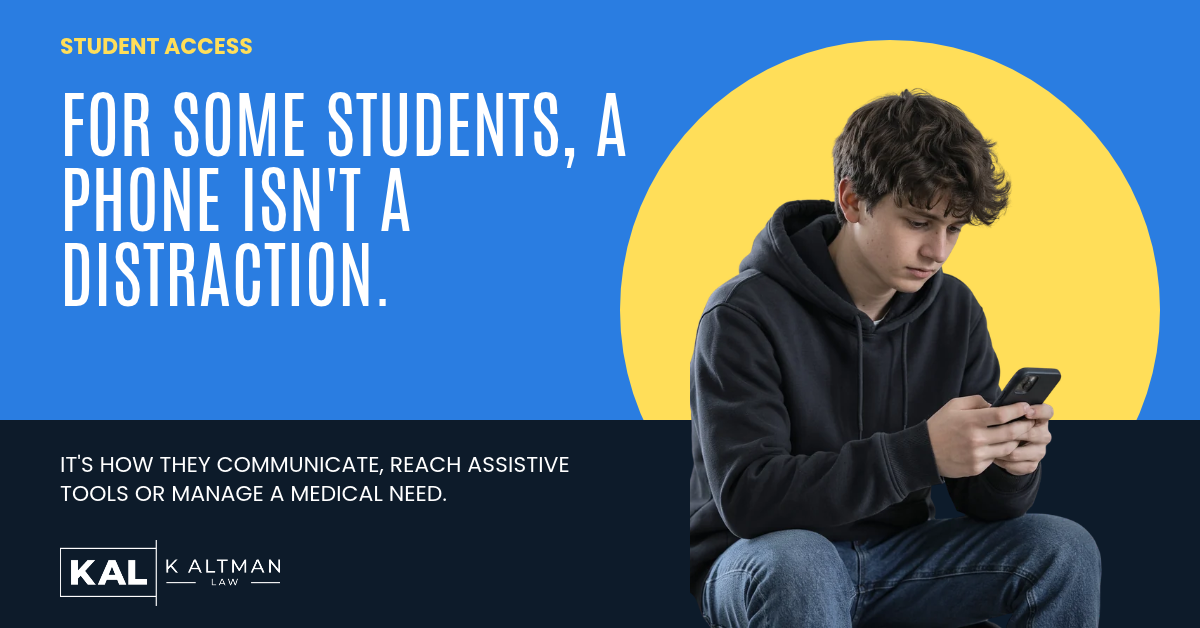

New research links strict phone restrictions to modest academic gains, while raising questions for families about accommodations, communication and enforcement
BOSTON, MA, UNITED STATES, November 23, 2026 /EINPresswire.com/ — As schools across the country restrict student cellphone use, K Altman Law is encouraging families and educators to look beyond whether a policy reduces distractions and consider how it affects students who need access to technology for learning, communication or medical reasons.
A new national study released November 17 by Harvard’s Center for Education Policy Research, with researchers from NWEA and Dartmouth, analyzed data from approximately 3.3 million students in 4,600 schools. Researchers found that schools using strict policies with lockable phone pouches experienced modestly higher growth in math and reading, which they estimated as equivalent to approximately one to two weeks of additional learning per year.
The findings add to an evolving discussion about student technology use, but they do not establish that every restriction will produce the same result or resolve questions about how individual students may be affected.
“Reducing distractions and protecting students’ individual needs should not be competing goals,” said Keith Altman, founder and managing partner of K Altman Law. “A well-designed policy should give families a clear understanding of the rules, provide a meaningful way to address disability-related needs, and respond to violations fairly.”
Accommodations and access deserve attention
Some students rely on phones or connected devices for accessibility, communication, assistive technology or management of medical conditions. Depending on the student’s needs and the applicable legal requirements, a school may need to consider how a restriction interacts with an Individualized Education Program, Section 504 plan or other appropriate accommodation.
Families should not assume that a general exception in a handbook automatically addresses their child’s circumstances. They can ask the school to explain how the policy will work in practice, including how a student will access a necessary device or an appropriate alternative throughout the day.
Clear rules and proportionate responses matter
Phone policies should tell students and families when devices must be stored, what exceptions are available, how a student can seek help or contact a family member, and what may happen if a rule is violated. When discipline is contemplated, families should ask for the applicable policy, the facts relied upon and the process for responding or challenging a decision. Relevant protections vary by jurisdiction, school and circumstance.
“Families should be able to understand both the expectations and the consequence before a problem arises,” Altman said. “When a student has a disability-related or medical need, schools and families should address that need directly rather than rely on a one-size-fits-all response.”
What families can do now
Request the written policy and ask when and where it applies, including during lunch, transitions and school activities.
Discuss individual needs with the IEP or Section 504 team, as applicable, including access to medical, communication or assistive technology and how any approved exception will work.
Ask about communication and emergencies, including how students can reach family members and how families will receive information during the school day.
Understand the consequences for violations and ask how the school handles repeated incidents, disputed facts and disability-related concerns.
Keep relevant records, including the policy, school communications and any written accommodation or disciplinary decision.
Families with questions about a student’s educational access or a proposed disciplinary action may seek advice tailored to their circumstances.
About K Altman Law
K Altman Law represents students and families in education-related matters, including Student Defense, Special Education, Title IX, civil rights and related disputes. For more information, visit kaltmanlaw.com.
This release is for general information only and is not legal advice. Applicable laws, school policies and available protections vary by jurisdiction and individual circumstances.
Keith Altman
K Altman Law
+1 888-984-1341
kalonline@kaltmanlaw.com
Visit us on social media:
LinkedIn
Instagram
Facebook
YouTube
TikTok
X
Legal Disclaimer:
EIN Presswire provides this news content “as is” without warranty of any kind. We do not accept any responsibility or liability
for the accuracy, content, images, videos, licenses, completeness, legality, or reliability of the information contained in this
article. If you have any complaints or copyright issues related to this article, kindly contact the author above.

Media gallery