Formation Metals Confirms Gold Continuity 200 Metres West of the Historical A-Zone with 1.18 g/t Au over 33 Metres, Including 7.79 g/t Au over 2.8 Metres, at the Advanced N2 Property
Hole N2-26-032 closes the 200-metre gap between the Company's western step-out and its Phase 1 drilling, confirming the
Press Release Disclaimer: This is a press release distributed through the XPR Media network. It has not been independently verified by our newsroom.


Hole N2-26-032 closes the 200-metre gap between the Company’s western step-out and its Phase 1 drilling, confirming the northern horizon of the A-Zone is continuous to the west at depths consistent with open-pit mining. The horizon remains open in every direction.
Highlights:
- 1.18 g/t Au over 33 metres from 96 metres vertical. N2-26-032 returned 1.18 g/t Au over 33 metres beginning at 138 metres downhole, including 7.79 g/t Au over 2.8 metres.
- 200 metres of gold continuity west of the historical A-Zone. N2-26-032 confirms the northern horizon across the 200 metres between Phase 1 hole N2-25-004 (0.83 g/t Au over 40.4 metres from 147.4 metres vertical), western step-out hole N2-26-022 (1.34 g/t Au over 12.5 metres from 131.7 metres vertical) and far western step-out hole N2-26-021 (1.05 g/t Au over 31.0 metres from 203.8 metres vertical). Four holes spaced 50 and 75 metres apart have now intersected gold-bearing intervals in the northern shallow horizon, in ground beyond the western boundary of the historical estimate.
- Open toward surface. The northern shallow horizon comes within 7 metres of surface 330 metres to the east, where N2-26-033 returned 0.98 g/t Au over 95.6 metres. It has not yet been drilled up-dip of N2-26-032, and Formation’s next step-outs will go north, toward the main deformation zone.
- Critical metals alongside gold. N2-26-032 also returned 0.33% zinc over 1.9 metres from 179.1 metres downhole. Assessing the Property’s copper and zinc potential is one of the objectives of the program, building on the massive-sulphide horizon identified by Agnico-Eagle in 20086.
- Program 35% complete, 65 holes pending. The Company has completed approximately 26,200 metres of drilling in 86 holes under its fully funded 75,000 metre program at N2, host to a global historic resource of ~871,000 ounces comprised of 18 Mt grading 1.4 g/t Au (~810,000 oz Au)2,3 and 243 Kt grading 7.82 g/t Au (~61,000 oz Au)2,4. Results have been reported for 21 holes, including those in this release, and are pending for the remaining 65 holes, approximately 19,100 metres. Results are also reported for three scout holes that tested ground up to 500 metres south of the northern horizon; none returned comparable widths or grades, reinforcing the Company’s focus on the northern horizon.
- Own technical team in place to clear the assay backlog. Assay reporting is several months behind the drilling after delays in outsourced core logging and cutting and in laboratory turnaround. The Company has brought core logging and cutting in-house, with its own technical team working alongside its contractor, and has added a second laboratory. The maiden Mineral Resource Estimate is now planned for 2027, so that it can include the pending results and the Company’s step-out drilling to the north, west and east of the A-Zone.
- The Company has working capital of ~C$23.6M5 with zero debt as at October 31, 2026.
VANCOUVER, BC / ACCESS Newswire / November 23, 2026 / Formation Metals Inc. (“Formation” or the “Company”) (CSE:FOMO)(FSE:VF1)(OTCQB:FOMTF), a North American mineral acquisition and exploration company, is pleased to announce partial assay results from N2-26-032 (results for the first 96 metres of the hole are pending), drilled northwest of the western core of the central A-Zone at its flagship N2 Property (“N2” or the “Property”), located 25 km south of Matagami, Quebec. Partial assay results confirm the hole intersected gold mineralization beginning at a downhole depth of 138 metres and continuing over a 33-metre interval. This intercept validates the continuity of the gold-bearing strike along the northern horizon of the A-Zone. Results are also reported for three holes drilled south of the northern horizon, and the Company provides an update on assay reporting.
Hole N2-26-032 was drilled on the northern horizon to test whether gold continues between Phase 1 hole N2-25-004 and the western step-out holes drilled earlier in 2026. The hole returned gold over 33 metres downhole, confirming that the horizon continues between them. The intercept shows the same mineralization style, alteration and structural controls as the northern horizon in Phase 1 hole N2-25-004 and 2026 westward step-out holes N2-26-022 and N2-26-021.
The principal intercepts in N2-26-032 are interpreted to represent the northern corridor’s gold-bearing vein system. Data from these intervals will be integrated into the three-dimensional geological model underpinning the Company’s upcoming maiden Mineral Resource Estimate, which is expected to improve confidence in the continuity of this part of the A-Zone.
The assay results from N2-26-032 (Table 2), combined with current geological interpretation, demonstrate that the primary gold-bearing intervals extend to vertical depths consistent with open-pit mining parameters and confirm the continuity of mineralization between the Company’s western step-out and its Phase 1 drilling.
The horizon remains open in every direction: along strike to the west beyond N2-26-021 and N2-26-022 and to the east beyond the A-Zone core; up-dip to the north, closer to surface and toward the main deformation zone; and down-dip to the south. Follow-up drilling will step out in each direction and tighten the spacing between the western step-out and the Phase 1 holes to build geological confidence. The up-dip step-outs will test whether the near-surface mineralization intersected in N2-26-033 continues this far west. The northern horizon is the priority of drilling going forward. All four 2026 holes reported on it to date (N2-26-021, N2-26-022, N2-26-033 and N2-26-032) intersected gold, over core lengths of 12.5 to 95.6 metres at 0.98 to 1.34 g/t Au, and results for further holes are pending.
Deepak Varshney, CEO of Formation Metals, stated: “Hole 32 connects the dots. In June we stepped out 200 metres west of the A-Zone and hit gold. The question since then has been whether that was an island or part of the same system. It is the same system: 1.18 g/t gold over 33 metres on the northern horizon, in the gap between the step-out and our Phase 1 drilling, starting less than 100 metres below surface and finishing in 7.79 g/t over 2.8 metres.”
Mr. Varshney continued: “What excites me most is what we have not drilled. About 330 metres east, the northern horizon gave us 0.98 g/t gold over 95.6 metres starting seven metres below surface, and we have not yet drilled above hole 32. The horizon is open toward surface, open at depth and open along strike in both directions. The northern horizon is now the priority of our drilling, and every one of these holes feeds the maiden Mineral Resource Estimate we are working toward.”
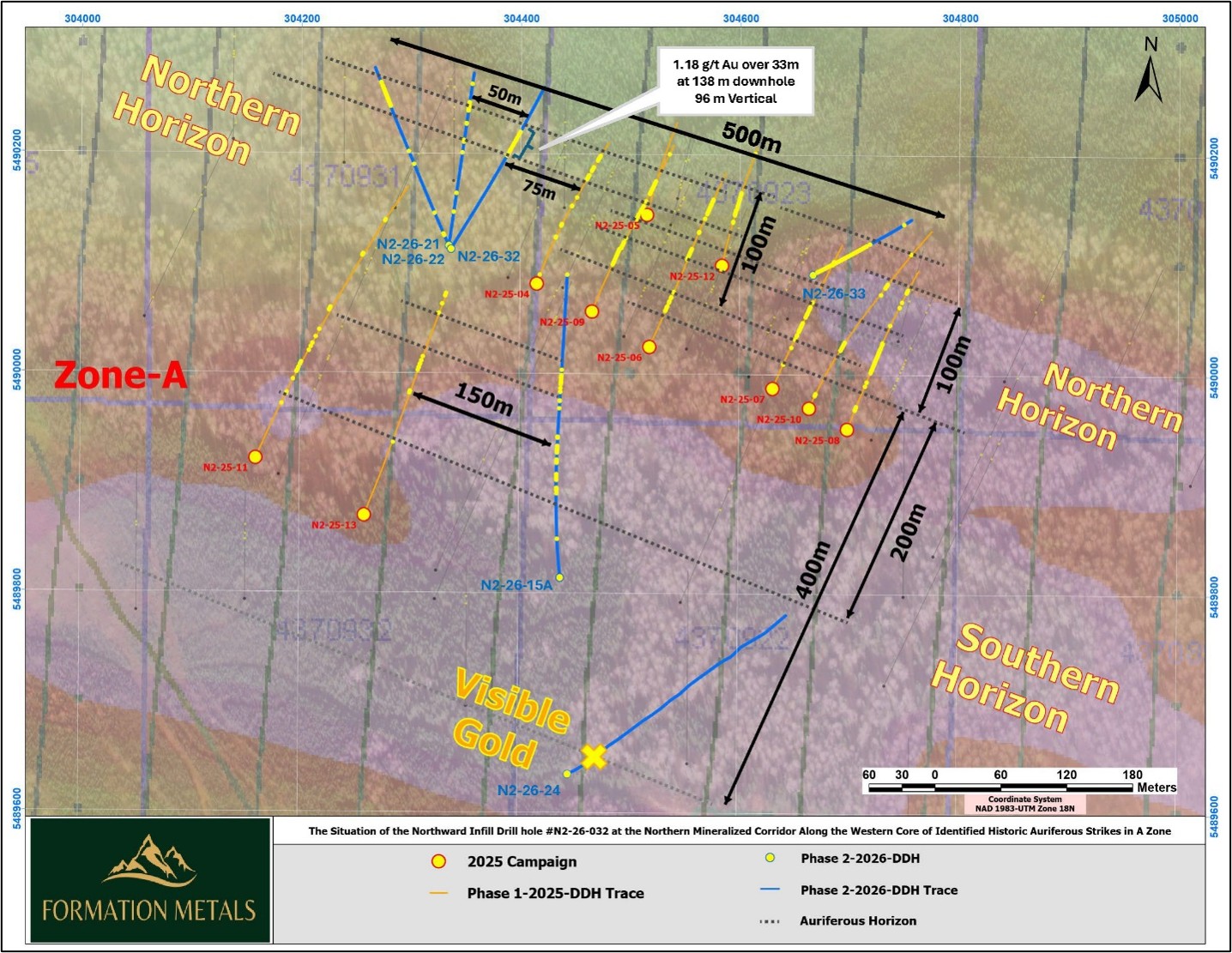
Figure 1 – Plan view of N2-26-032 and the Phase 1 drilling on the northern horizon of the western core of the A-Zone. N2-26-032 confirms the continuity of auriferous strike in the northern horizon along 200 metres of strike.
The Company’s drilling campaign has exceeded expectations, confirming geological continuity and delivering robust and continuous gold intercepts including:
Table 1 – Previously Reported Intercepts
|
Hole |
Au (g/t) |
Length (m) |
From (m) |
Vertical depth (m) |
Including |
|---|---|---|---|---|---|
|
N2-25-004 |
0.83 |
40.4 |
180.0 |
147.4 |
1.36 g/t Au over 9.0 m |
|
N2-25-005 |
0.91 |
42.3 |
14.0 |
9.9 |
2.04 g/t Au over 8.1 m; 1.31 g/t Au over 11.4 m |
|
N2-25-006 |
1.8 |
21.9 |
154.4 |
133.7 |
3.4 g/t Au over 4.8 m |
|
N2-25-007 |
1.3 |
22.2 |
139.9 |
121.2 |
2.36 g/t Au over 10.5 m |
|
N2-25-008 |
0.95 |
61.1 |
109 |
94.4 |
1.68 g/t Au over 26.5 m |
|
N2-25-009 |
1.37 |
24.0 |
168.9 |
146.3 |
2.05 g/t Au over 13.3 m |
|
N2-25-010 |
1.43 |
19.4 |
117.5 |
101.8 |
2.23 g/t Au over 7.0 m |
|
N2-25-012 |
1.75 |
30.4 |
64.1 |
45.3 |
3.51 g/t Au over 10.5 m; 19.2 g/t Au over 0.51 m |
|
N2-26-15A |
1.41 |
20.6 |
499.1 |
447.5 |
2.63 g/t Au over 5.5 m; 1.78 g/t Au over 7.2 m |
|
N2-26-021 |
1.05 |
31.0 |
243.0 |
203.8 |
1.89 g/t Au over 12.0 m |
|
N2-26-022 |
1.34 |
12.5 |
177.2 |
131.7 |
2.29 g/t Au over 6.9 m |
|
N2-26-033 |
0.98 |
95.6 |
8.4 |
7.1 |
3.14 g/t Au over 10.0 m |
Based on these results, the Company believes the A-Zone hosts a robust mineralized veining system that fluctuates between 20 and 75 metres in thickness, is potentially 300-500 metres wide, with a potential of up to 8 km in strike. The A-Zone remains open in multiple directions, specifically along strike (E-W), up-dip (N) and down-plunge/depth (S).
Drill Results
N2-26-032 was drilled on the northwestern side of the western core of the A-Zone, as an infill hole between the Company’s Phase 1 drilling and its western step-out, and returned gold over 33 metres from 138 metres downhole.
Results are also reported for three holes drilled approximately 350 to 500 metres south of the northern horizon (Tables 2 and 3). All three are steep holes that tested at depth south of the horizon rather than across it, and they returned narrow or low-grade intervals. N2-26-024 is the hole in which the Company reported visible gold on April 21, 2026; the sample containing the visible gold returned 1.1 g/t Au over 1.0 metre by metallic screen analysis, and the best interval elsewhere was 0.73 g/t Au over 10.0 metres from 263.0 metres. Results for this hole are partial, with samples from 548 to 644 metres downhole pending. N2-26-020, a 701 metre scout hole, returned a best interval of 0.58 g/t Au over 6.6 metres from 621.3 metres, including 3.94 g/t Au over 0.8 metres. N2-26-015 was abandoned at 207 metres with no significant values and was redrilled as N2-26-15A, reported on September 8, 2026.
Table 2 – Significant Intercepts for N2-26-032, N2-26-020, N2-26-024 and N2-26-015
|
Hole ID |
Au (g/t) |
From |
To |
Length (m) |
|
|---|---|---|---|---|---|
|
N2-26-032 |
1.18 |
138 |
171 |
33 |
|
|
Including |
0.87 |
138 |
152 |
14 |
|
|
Including |
0.82 |
156 |
162 |
6 |
|
|
Including |
7.79 |
168.2 |
171 |
2.8 |
|
|
0.36 |
177 |
178 |
1 |
||
|
0.42 |
229.5 |
230.9 |
1.4 |
||
|
N2-26-020 |
0.32 |
33.0 |
39.5 |
6.5 |
|
|
0.37 |
172.0 |
180.5 |
8.5 |
||
|
1.42 |
196.0 |
197.1 |
1.1 |
||
|
0.34 |
225.5 |
235.0 |
9.5 |
||
|
0.17 |
244.4 |
263.5 |
19.1 |
||
|
0.89 |
286.0 |
288.5 |
2.5 |
||
|
0.80 |
584.9 |
587.3 |
2.4 |
||
|
2.33 |
605.2 |
605.8 |
0.6 |
||
|
0.58 |
621.3 |
627.9 |
6.6 |
||
|
Including |
3.94 |
627.1 |
627.9 |
0.8 |
|
|
N2-26-024 |
1.10 |
151.0 |
152.0 |
1.0 |
|
|
0.55 |
159.0 |
165.0 |
6.0 |
||
|
0.38 |
212.0 |
223.0 |
11.0 |
||
|
0.73 |
263.0 |
273.0 |
10.0 |
||
|
0.36 |
650.0 |
658.0 |
8.0 |
||
|
0.20 |
675.2 |
689.3 |
14.1 |
||
|
N2-26-015 |
NSV |
36.6 |
207.0 |
170.4 |
Note 1: Illustrated mineralization intercepts are not directly representative of true width. Based on interpreting the angle of intersection, the estimated true width of the mineralized lens generally corresponds to approximately 66% of the intercepted core length for N2-26-032.
Note 2: Reported intervals are length-weighted averages and composited using a minimum cut-off grade of 0.1 g/t Au for higher-grade intervals. The 33-metre interval in N2-26-032 comprises three mineralized intervals of 14.0, 6.0 and 2.8 metres, separated by 4.0 metres (152.0 to 156.0 metres) and 6.2 metres (162.0 to 168.2 metres) grading less than 0.1 g/t Au. Both are included in the 1.18 g/t Au average at their assayed grades.
Note 3: NSV means no significant values (maximum 0.12 g/t Au). Results for N2-26-024 are partial, with samples from 548 to 644 metres pending; its 1.10 g/t Au interval is the sample containing visible gold, analysed by metallic screen. True widths for N2-26-020, N2-26-024 and N2-26-015 are not known.
Table 3 – Drillhole Information
|
Drill Hole |
Coordinate |
Length (m) |
Survey |
|||
|
Easting |
Northing |
Zone |
Dip |
Azimuth |
||
|
N2-26-032 |
304337 |
5490113 |
18 |
231 |
-45 |
N32 |
|
N2-26-015 |
304438 |
5489814 |
18 |
207 |
-74 |
N358 |
|
N2-26-020 |
304117 |
5489984 |
18 |
701 |
-79 |
N24 |
|
N2-26-024 |
304446 |
5489635 |
18 |
689 |
-73 |
N64 |
A key highlight of N2-26-032 is that it remained entirely within a continuous package of sheared and deformed mafic volcanics from top to bottom. This structural zone is characterized by pervasive sericitization, carbonatization, and silicification, alongside quartz and quartz-carbonate veining containing up to 10% disseminated and stringer sulfides, predominantly pyrite, with minor arsenopyrite and sphalerite (Table 4).
Table 4 – Mineralization Summary, N2-26-032
|
Drill Hole |
Mineralized Section (m) |
Main Auriferous Interval |
|||||
|
Total (m) |
#1 |
Length (m) |
Interval |
Vertical Depth |
Mineralization |
Au (ppm) |
|
|
N2-26-032 |
216 |
15 m to 231 m (top to bottom) |
33 |
138 m to 171 m |
96 m to 118 m |
Pyrite, Arsenopyrite |
1.18 |
The high-grade gold interval in N2-26-032, grading 7.79 g/t Au over 2.8 metres from 168.2 m to 171.0 m, is associated with significant veining, alteration, and disseminated mineralization. This high-grade gold intercept comprises a laminated to brecciated quartz-carbonate vein system containing entrained, sheared wall-rock fragments, typical of a robust multi-phase orogenic shear-zone-hosted gold deposit (Fig. 2).
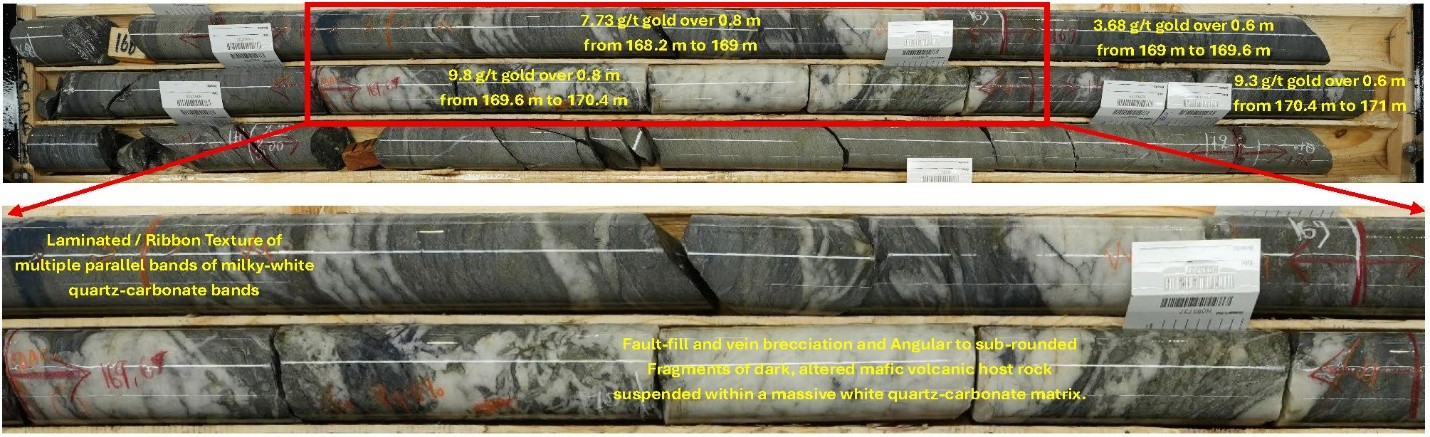
Figure 2 – Multi-Phase Quartz-Carbonate Veining and Wall-Rock Brecciation in High-Grade interval of Hole N2-26-032
Assay Reporting Update
Assay results from the 2026 program are several months behind the drilling. Core logging and cutting, which were outsourced, took significantly longer than scheduled, and laboratory turnaround has been well beyond normal. The Company has since added a second laboratory and brought core logging and cutting in-house, with its own technical team working alongside its contractor to clear the backlog. The maiden Mineral Resource Estimate is now planned for 2027, which allows it to incorporate the pending assays and the Company’s step-out drilling north, west and east of the A-Zone. The 86 holes drilled to date include 10 that were abandoned or stopped short and restarted, and results will be reported as they are received and verified.
The NQ-size holes were drilled by Forage DCB Drilling. Core was transported to a logging facility in Val-d’Or and then to Technominex’s facility in Rouyn-Noranda, where it was logged and sawn in half with a water-cooled diamond saw. Samples were taken at 0.5 to 1.5 metre intervals, with lengths set by geological features. Samples, along with standards and blanks, were tagged and stored securely until shipped to AGAT Laboratories Ltd. in Val-d’Or, Quebec.
Project Summary
Comprising 87 claims totaling ~4,550 ha within the Abitibi sub province of Northwestern Quebec, Formation’s flagship N2 Property is an advanced gold project with a global historic resource of ~871,000 ounces comprised of 18 Mt grading 1.4 g/t Au (~810,000 oz Au)2,3 and 243 Kt grading 7.82 g/t Au (~61,000 oz Au)2.
There are six primary auriferous mineralized zones in total, each open for expansion along strike and at depth. Compilation and geophysical work by Balmoral Resources Ltd. (now Wallbridge Mining) from 2010 to 2018 generated numerous targets that are being investigated for the first time by Formation with diamond drilling.
Historical highlights from the top two priority zones include:
- A Zone: a shallow, highly continuous, low-variability historic gold deposit with ~522,900 ounces identified at a grade of 1.52 g/t Au. ~15,000 metres have been drilled historically across 1.65 km of strike, with 84% of historical drillholes intersecting auriferous intervals including up to 1.7 g/t over 35 metres.
- RJ Zone: a high-grade historic gold deposit with ~61,100 ounces identified at a grade of 7.82 g/t Au, with high-grade intercepts from historical drill holes as high as 51 g/t Au over 0.8 metres and 16.5 g/t Au over 3.5 metres2. This zone was the target of the most recent drilling at the Property by Agnico-Eagle Mines in 2008, when the price of gold was ~US$800/oz. Only ~900 metres of strike has been drilled, with about 7 km of strike remaining to be tested.
The Company’s internal view and evaluations suggest that N2 exhibits a strong geological potential possessing favorable characteristics to support a near-surface, open-pit resource development. This optimism is driven by several key factors:
- Shallow system, mostly untested along strike: The A-Zone is the near-surface part of a corridor the Company interprets to extend approximately 8 km across the Property. Historical drilling tested about 1.65 km of it, leaving more than 6 km undrilled for near-surface mineralization.
- Higher-grade target at depth: The RJ Zone, on the same corridor, farther south, hosts higher-grade mineralization at depth. About 0.9 km of its strike has been drilled, with about 7 km untested. All zones remain open at depth, with most historical drilling stopping by about 350 metres.
- Wide, Continuous Near-Surface Intercepts: Recent drilling has confirmed thick zones (100-200+ m) of target mineralization starting near surface, ideal for bulk-tonnage open-pit scenarios with low strip ratios and high tonnage potential.
- Regional Analogy and Pedigree: Located in the Casa Berardi trend, which hosts multiple multi-million-ounce deposits (e.g., Casa Berardi, which has produced more than 3.2 Moz, and Douay), N2 shares similar geology and structural controls. Nearby Vezza produced from higher-grade underground mining, but N2’s shallower, wider zones suggest superior open-pit economics.
- Untested Targets: Compilation work identified numerous geophysical anomalies (IP, EM, VTEM) that remain undrilled, providing discovery potential beyond known zones.
- Rising Gold Prices and Economic Viability: At current gold prices, lower-grade bulk-tonnage deposits become highly attractive, enhancing the project’s upside.
Strategically located 25 km south of the mining town of Matagami, Quebec, the Property has year-round access via provincial highway and logging road, proximity to skilled labour, power infrastructure and established mining services, in a district that has produced in excess of 200 million ounces of gold. The Property lies along the Casa Berardi mine trend, which hosts multiple million-ounce gold deposits, and sits approximately 1.5 kilometres east of the former-producing Vezza gold mine, which produced over 100,000 ounces of gold from 2013 to 2019 by underground methods.
The region’s robust infrastructure supports toll milling opportunities, with potential access to nearby processing facilities such as those at Casa Berardi or other Abitibi mills, enabling cost-effective development without the need for on-site mill construction.
The Company also believes that N2 has significant base metal potential, where it recently completed a revaluation process which revealed significant copper and zinc intercepts within historic drillholes known to have significant gold grades (>1 g/t Au). Assay results range from 200 to 4,750 ppm and 203 ppm to 6,700 ppm, for copper and zinc, respectively, indicating strong potential for elevated base metal (Cu-Zn) concentrations across the property, specifically at the A and RJ zones. Property wide geology at N2 features volcanic and sedimentary rocks formed in regional anticlinal and synclinal flexures. Three principal deformation structures, oriented along the known NW-SE to WNW-ESE structural trends typical of VMS deposits in the Matagami region, function as critical geologic controls for mineralization on the property.
Copper and zinc are on Canada’s critical minerals list, and assessing the Property’s base metal potential is one of the objectives of the Company’s program. In 2007 and 2008, Agnico-Eagle Mines targeted a volcanogenic massive sulphide (VMS) style horizon at the contact between volcanic and sedimentary rocks on the RJ side of the Property, intersecting massive sulphide, mainly pyrite, over core lengths of 0.15 metres to more than 1 metre in three drill holes at downhole depths greater than 500 metres; two follow-up holes later in 2008 did not intersect massive sulphide6. Historical assays on the Property include up to 0.67% zinc and 0.46% copper over individual samples. In N2-26-032, 0.33% zinc over 1.9 metres was returned from 179.1 metres downhole, below the main gold interval.
Qualified person
The technical content of this news release has been reviewed and approved by Mr. Babak V. Azar, P.Geo., géo (OGQ#10876) an independent contractor and a qualified person as defined by National Instrument 43-101. Historical reports provided by the optionor were reviewed by the qualified person.
Quality Assurance and Quality Control
The quality assurance and quality control protocols include insertion of blank or standard samples every 10 samples on average and duplicates every 50 samples during the analytical process. The gold analyses were completed by fire assay (FA) method with an Atomic Absorption (AAS) finish on 50 grams of materials at the AGAT Laboratories Ltd in Thunder Bay, Ontario, Canada, following sample preparation at AGAT in Val-d’Or, Quebec. The repeats were carried out by FA followed by gravimetric testing on each sample containing 10.0 g/t gold or more. Total gold analyses (metallic sieve) were carried out on the samples which presented a great variation of their gold contents or the presence of visible gold. Zinc and other base metals were determined on selected samples by four-acid digestion with an ICP-OES finish (method 201-070) at AGAT’s laboratory in Calgary, Alberta. AGAT is independent of the Company.
About Formation Metals Inc.
Formation Metals Inc. is a North American mineral acquisition and exploration company focused on the development of quality properties that are drill-ready with high-upside and expansion potential. Formation’s flagship asset is the N2 Property, an advanced gold project with a global historic resource of ~871,000 ounces (18 Mt grading 1.4 g/t Au (~810,000 oz Au) across four zones (A, East, RJ-East, and Central)2,3 and 243 Kt grading 7.82 g/t Au (~61,000 oz Au) across the RJ zone2,4) and six mineralized zones, each open for expansion along strike and at depth including the “A” zone, the near-surface northern part of a corridor interpreted to extend approximately 8 km, of which about 1.65 km has been drilled (more than 6 km open), and the “RJ” zone, host to historical high-grade intercepts as high as 51 g/t Au over 0.8 metres.
FORMATION METALS INC.
Deepak Varshney, CEO and Director
For more information, please call 778-899-1780, email dvarshney@formationmetalsinc.com or visit www.formationmetalsinc.com.
Neither the Canadian Securities Exchange nor its Regulation Services Provider accepts responsibility for the adequacy or accuracy of this release.
Notes and References:
- Readers are cautioned that the geology of nearby properties is not necessarily indicative of the geology of the Property.
- The above referenced resource estimates do not have a category, are considered historical in nature, and are based on prior data prepared by a previous property owner, and do not conform to current CIM categories.
While the Company considers the estimates to be reliable, a qualified person has not done sufficient work to classify the historical estimates as current resources in accordance with current CIM categories and the Company is not treating the historical estimates as a current resource. A 0.5 g/t Au cut-off was used in the preparation of the historical estimates with a minimum 2.5 metre mining width.
Significant data compilation, re-drilling, re-sampling and data verification may be required by a qualified person before the historical estimates can be classified as current resources. There can be no assurance that any of the historical mineral resources, in whole or in part, will ever become economically viable. In addition, mineral resources are not mineral reserves and do not have demonstrated economic viability. The Company is not aware of any more recent estimates prepared for the N2 Property.
- Needham, B. (1994), 1993 Diamond Drill Report, Northway Joint Venture, Northway Property; Cypress Canada Inc.; 492 pages.
- Guy K. (1991), Exploration Summary May 1, 1990 to May 1, 1991 Vezza Joint Venture Northway Property; Total Energold; 227 pages.
- Working capital is calculated as current assets less current liabilities and is based on the Company’s unaudited internal accounts as at October 31, 2026. It is not a standardized financial measure under IFRS and may not be comparable to similar measures disclosed by other issuers.
- de Chavigny, B. (2008), Rapport des travaux, Volume A, Campagne de forage automne-hiver 2007-2008, Propriété Northway (PN-154), canton Noyon; Mines Agnico-Eagle Ltée; GM 64253; and de Chavigny, B. (2008), Rapport des travaux, Campagne de forage automne 2008, Propriété Northway (PN-154); Mines Agnico-Eagle Ltée; GM 64146.
Forward-looking statements:
This news release includes “forward-looking statements” under applicable Canadian securities legislation, including statements respecting: the Company’s plans for the Property and the expected timing and scope of the drilling program at the Property; the Company’s planned 75,000-metre drilling program; planned follow-up drilling at the A-Zone; the timing of assay results; and the timing and results of the Company’s planned maiden Mineral Resource Estimate. Such forward-looking information reflects management’s current beliefs and is based on a number of estimates and/or assumptions made by and information currently available to the Company that, while considered reasonable, are subject to known and unknown risks, uncertainties, and other factors that may cause the actual results and future events to differ materially from those expressed or implied by such forward-looking statements. Readers are cautioned that such forward-looking statements are neither promises nor guarantees and are subject to known and unknown risks and uncertainties including, but not limited to, general business, economic, competitive, political and social uncertainties, uncertain and volatile equity and capital markets, lack of available capital, actual results of exploration activities, environmental risks, future prices of base and other metals, operating risks, accidents, labour issues, delays in obtaining governmental approvals and permits, and other risks in the mining industry.
The Company is presently an exploration stage company. Exploration is highly speculative in nature, involves many risks, requires substantial expenditures, and may not result in the discovery of mineral deposits that can be mined profitably. Furthermore, the Company currently has no reserves on any of its properties. As a result, there can be no assurance that such forward-looking statements will prove to be accurate, and actual results and future events could differ materially from those anticipated in such statements.
SOURCE: Formation Metals Inc.
View the original press release on ACCESS Newswire
Media gallery