The DCIA Gold Rush: Challenges in Building a Federal Debt Collection System
Key TakeawaysThe Debt Collection Improvement Act of 1996 (DCIA) changed how eligible delinquent federal debts were
Press Release Disclaimer: This is a press release distributed through the XPR Media network. It has not been independently verified by our newsroom.

Key Takeaways
- The Debt Collection Improvement Act of 1996 (DCIA) changed how eligible delinquent federal debts were referred for collection.
- Federal agencies struggled with inconsistent procedures, outdated systems, and identifying debts eligible for referral.
- The Government Accountability Office (GAO) identified weaknesses and recommended improvements.
- In 2003, GAO found that Treasury’s reported debt referral rate was significantly higher than its own calculation.
- These findings illustrate why accurate records, accountability, and oversight matter in federal debt collection.
Passing a Law Was the Easy Part
Have you ever received a letter from a government office you weren’t expecting, about a debt that originally belonged to another federal agency?
You might wonder how your account ended up there, who is responsible for it, and whether the information being used to collect it is accurate.
Part of the answer begins in 1996.
Congress passed the Debt Collection Improvement Act (DCIA) to strengthen the federal government’s collection of delinquent debt. The law established requirements for transferring eligible delinquent federal debts to Treasury for collection.
But passing legislation and building a system that works are two very different things.
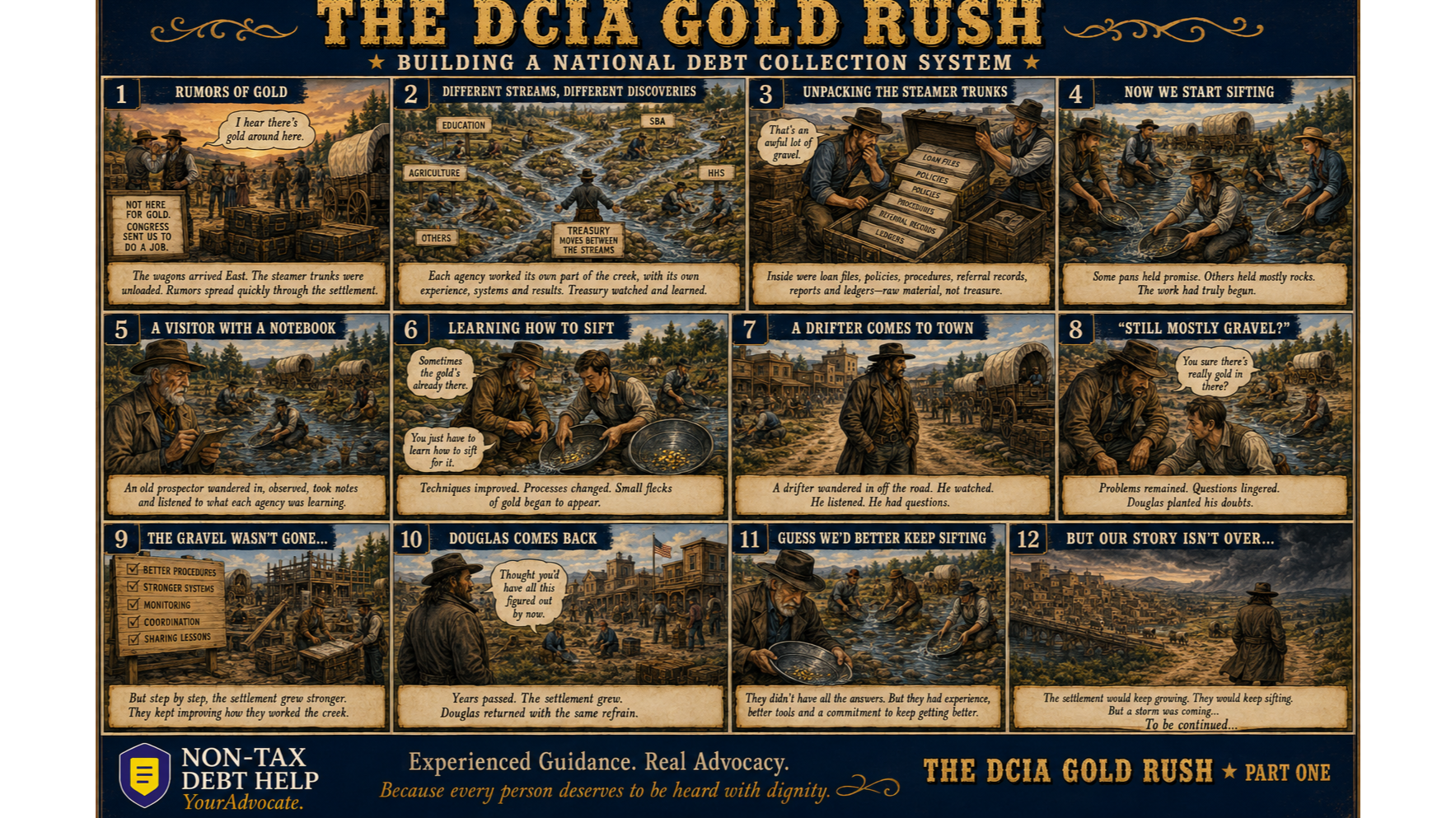
The Federal Debt Collection Gold Rush
Think of the early implementation of the DCIA as a Gold Rush.
Federal agencies were like prospectors arriving at a new settlement. Each brought different equipment, experience, and ways of working. Treasury was tasked with bringing those efforts together into a more coordinated collection system.
The gold represented the results Congress hoped to achieve. The gravel represented the problems agencies would have to work through to get there.
And there was plenty of gravel.
Some agencies already had experience using collection tools such as administrative wage garnishment. Others were still developing the necessary regulations, procedures, and hearing processes.
Government investigators soon discovered that implementing the new law wasn’t going to be as straightforward as anyone might have hoped.
What the Government Investigators Found
The Government Accountability Office (GAO), formerly the General Accounting Office, examined how agencies were implementing the DCIA.
Its findings revealed difficulties identifying debts eligible for referral, transferring them promptly, and maintaining reliable information.
At the Centers for Medicare & Medicaid Services, for example, GAO identified weaknesses in procedures and controls that contributed to delayed referrals and unreliable debt reporting.
At the Department of Agriculture’s Farm Service Agency, GAO recommended improvements to automated systems and procedures for identifying eligible debts. Those recommendations were later implemented.
The solution wasn’t simply collecting more money.
It required improving the way agencies identified, tracked, reported, and referred delinquent debts.
When the Numbers Didn’t Add Up
By 2003, Treasury considered its Cross-Servicing program mature.
Cross-Servicing is the federal collection program through which Treasury performs collection activities on eligible delinquent debts referred by other federal agencies.
But GAO’s 2003 review revealed something worth examining.
Treasury’s Financial Management Service reported that approximately 96% of eligible debt had been referred for Cross-Servicing at the end of fiscal year 2002.
GAO calculated the rate at approximately 79%.
That difference raised important questions about the accuracy of the information being used to measure the program’s performance.
GAO also reported that private collection agency contractors had returned approximately $3.9 billion in uncollected debts during fiscal years 2000 through 2002, raising additional questions about potential collection opportunities.
These weren’t just numbers on a spreadsheet. They demonstrated why oversight and accurate reporting were essential to building a reliable collection system.
Read the findings in GAO’s 2003 Cross-Servicing report.
Why This Matters to You
The collection system developed under the DCIA continues to affect individuals and businesses with delinquent federal debts.
An account may begin with one federal agency and later be transferred to the Bureau of the Fiscal Service for collection. The original agency generally remains the creditor, even when another office handles collection activities.
Understanding that distinction matters when you need to determine who is collecting your debt, question a balance, or request information about your account.
The early history of the DCIA teaches an important lesson: A government collection process can be established and still require oversight, accurate records, and improvements.
At Non-Tax Debt Help, we help individuals and businesses understand federal non-tax debt collection processes and the options available for addressing their circumstances.
Because understanding how the system works is an important first step toward knowing what to do next.
SBA & Federal Debt Advisory Services
youradvocate@nontaxdebthelp.com
+1-830-205-2884
143 Exchange Blvd – Suite 300-41
Hutto
TX
78634
United States