
Risk Assessment Beyond Diagnosis Codes: Why Healthcare Organizations Need a More Complete View of Patient Risk
Equipo Health highlights how AI-powered clinical intelligence can uncover hidden patient risks, improve risk accuracy,
Press Release Disclaimer: This is a press release distributed through the XPR Media network. It has not been independently verified by our newsroom.
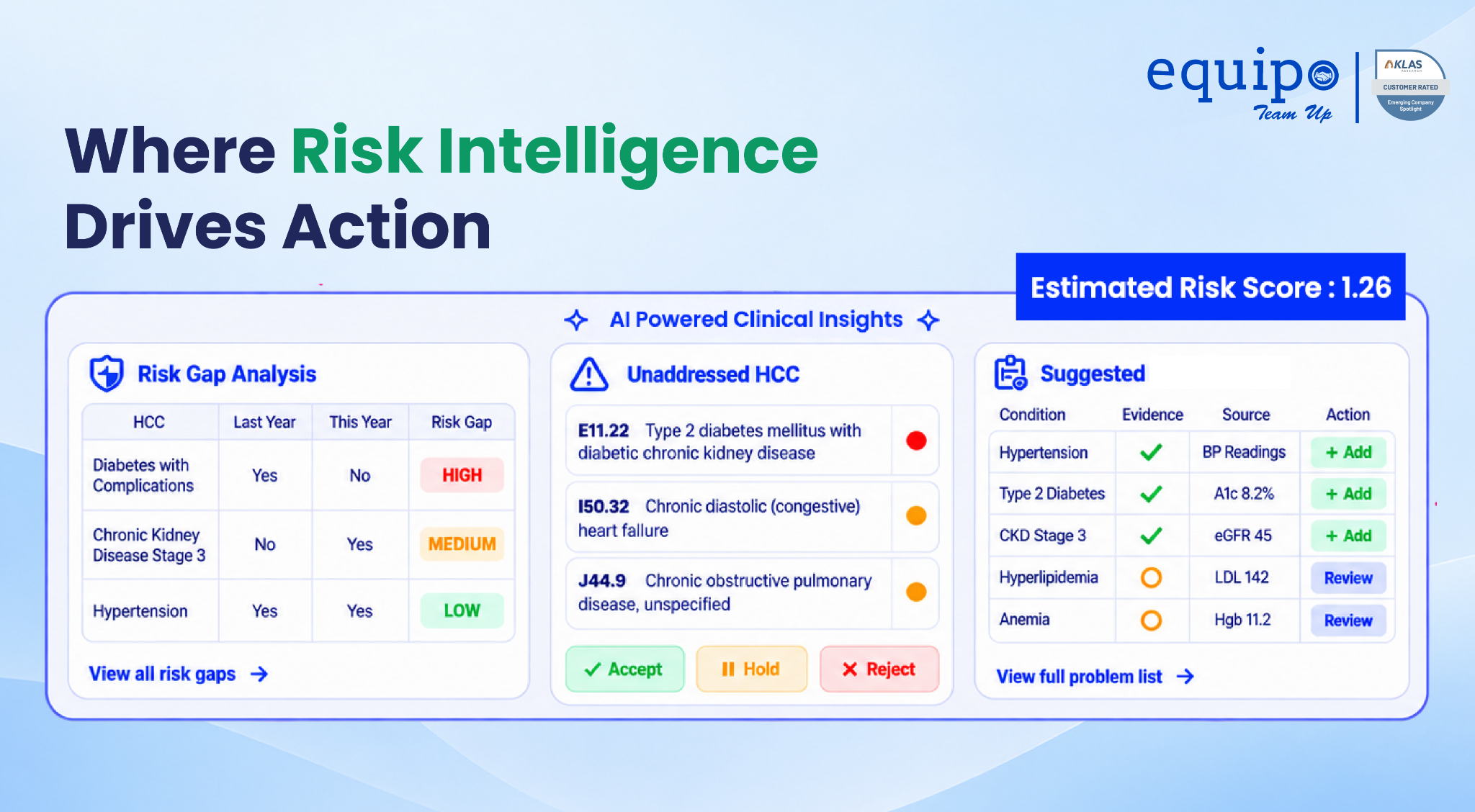

Equipo Health highlights how AI-powered clinical intelligence can uncover hidden patient risks, improve risk accuracy, and strengthen value-based care decisions
SOUTH PLAINFIELD, NJ, UNITED STATES, November 3, 2026 /EINPresswire.com/ — Research highlights the limitations of diagnosis-code-based risk assessment and points to the growing importance of connected clinical data in value-based care.
Risk scores influence how healthcare organizations understand patient populations, allocate resources, assess performance, and manage financial risk. In value-based care, these scores can shape reimbursement, care management priorities, and the way providers are evaluated. Yet the accuracy of a risk score depends on the quality and completeness of the information used to calculate it.
Diagnosis codes provide an important foundation for risk adjustment. However, they do not always capture the full picture of a patient’s health. Relevant conditions may appear in clinical notes, assessments, and other medical records without being reflected in structured diagnosis lists. When these details are missed, organizations may underestimate patient complexity and make decisions based on an incomplete view of risk.
Recent analysis published on 31 October 2026, brings this issue into focus. Drawing on published research from the United States and Finland, the article examines how diagnosis-code-based risk scores can fail to reflect actual patient complexity, distort mortality predictions, and change hospital performance rankings when compared with clinical information from the broader medical record.
Recent research reinforces this concern. It also raises a broader question for healthcare leaders: how can organizations make risk assessment more representative of the patients they serve?
When Diagnosis Codes Fail to Reflect Patient Risk
A 2018 study published in The American Journal of Managed Care, titledhttps://pubmed.ncbi.nlm.nih.gov/29350512/ examined the accuracy of electronic health record problem lists in identifying patients’ underlying health conditions.
Researchers reviewed records from 1,596 men treated at two Veterans Affairs medical centers. They compared comorbidity information recorded in EHR problem lists with information identified through manual review of clinical notes.
The findings revealed substantial gaps. The problem lists captured only 23% of documented congestive heart failure cases, 42% of chronic obstructive pulmonary disease cases, and 46% of diabetes cases. While the problem lists were generally specific when a condition was recorded, they missed a significant proportion of conditions documented elsewhere in the medical record.
The difference also affected risk prediction. Comorbidity scores calculated from clinical notes predicted long-term mortality, while scores based on problem lists did not. The researchers concluded that inaccuracies in EHR problem-list data could lead to incorrect assessments of patient case mix and should be validated before being used for risk adjustment.
A more recent study published in Computational and Structural Biotechnology Journal in 2025 found similar limitations across a much larger dataset. Researchers analyzed 10.6 million free-text EHR entries from 102,525 patients in Finland. Using natural language processing, they identified conditions such as falls and incontinence in clinical documentation and compared those findings with diagnosis codes.
The model identified 31,987 instances of falls in clinical text, compared with 4,090 identified through diagnosis codes. For incontinence, it identified 7,059 instances in clinical text, compared with 3,873 through codes. The study also found that conditions identified in clinical notes had stronger associations with mortality than those identified through diagnosis codes alone.
These findings point to a recurring challenge. Important clinical information exists across the medical record, but structured diagnosis data may not consistently reflect it. For healthcare organizations that depend on accurate risk assessment, this creates a gap between the patient’s documented clinical reality and the risk profile used to guide decisions.
Building a More Complete Picture of Patient Risk.
Addressing this gap requires healthcare organizations to look beyond isolated diagnosis lists and consider the broader clinical information available across their systems.
Clinical notes, assessments, medical history, encounter documentation, and other patient records can contain details that are relevant to understanding disease burden and patient complexity. Bringing these sources together can help organizations develop a more informed view of their populations and identify areas that may require further clinical or coding review.
This is an important part of the approach behind Equipo Health’s healthcare intelligence platform. Equipo brings clinical, operational, and patient engagement information together to support population health management, risk analysis, care coordination, and reporting.
Its Foresight AI capabilities include a Risk Analyzer Engine designed to review unstructured clinical documentation and identify potential coding gaps, undocumented conditions, and other clinical information that may be relevant to risk assessment. By examining information beyond structured diagnosis data, the engine is intended to help surface details that may otherwise remain difficult to identify across large volumes of patient records.
The value of this approach extends beyond identifying individual conditions. Healthcare organizations need to understand how patient risk is distributed across their populations, which patients may require closer attention, and where care teams should focus their efforts.
Equipo’s broader platform connects risk intelligence with population analytics and care management capabilities. This creates an operational context for the insights: information identified through analysis can inform patient review, care planning, outreach, and ongoing coordination.
The distinction is important. AI-supported analysis can help surface relevant information and guide further review, but clinical judgment and appropriate coding validation remain essential. Technology should support better-informed decisions, with healthcare professionals retaining responsibility for clinical interpretation and coding determinations.
The Financial Implications of Inaccurate Risk Assessment.
Incomplete risk information can have consequences beyond analytics. In value-based care arrangements, risk adjustment influences financial calculations, performance benchmarks, and how organizations understand the resources required to manage their patient populations.
When a patient’s documented condition is not reflected in the data used for risk assessment, the resulting score may underrepresent the complexity of that patient. This can affect financial projections and the way organizations evaluate the resources required to deliver appropriate care.
A 2022 study published in Health Affairs, titled Evaluating the Accuracy of Medicare Risk Adjustment for Alzheimer’s Disease and Related Dementias, examined the alignment between claims-based dementia identification and clinician-reviewed patient records. The researchers found that 22.7% of beneficiaries identified as having Alzheimer’s disease or related dementias through clinical review did not have a corresponding dementia diagnosis in claims data. Conversely, 34% of beneficiaries with a dementia code did not have the condition confirmed through clinical review.
The study also found that Medicare spending for beneficiaries with clinically identified dementia that was not captured in claims was $14,619 higher per beneficiary than for those whose dementia was correctly identified in claims.
This finding illustrates the financial significance of incomplete risk information. Patients whose conditions are not adequately represented in claims data may have care needs and associated costs that are not reflected in the risk profile used for financial assessment.
At the same time, inaccurate or unsupported diagnosis information creates compliance and audit concerns. Organizations need to be able to substantiate the conditions used in risk adjustment with appropriate clinical documentation. A higher score is not inherently a better score; accuracy and supporting evidence are what make it meaningful.
For healthcare leaders, the objective should therefore be a more reliable understanding of patient risk. This includes identifying potential gaps, reviewing supporting documentation, and ensuring that financial and operational decisions are based on an accurate representation of the population.
By bringing risk analytics into a broader healthcare intelligence environment, Equipo aims to help organizations examine patient risk alongside clinical information and care management needs. This supports a more informed approach to population assessment, financial planning, and operational prioritization.
Beyond Financial Accuracy: The Impact on Care Delivery.
The implications of incomplete risk assessment extend into everyday care delivery. Risk scores and patient classifications can influence which individuals receive additional attention, how care management resources are distributed, and which populations are prioritized for intervention.
If a patient’s clinical complexity is underrepresented, that patient may not receive the level of attention their needs warrant. A condition documented in a progress note or assessment may be relevant to care planning even when it is absent from a structured diagnosis list.
For organizations managing large and diverse populations, identifying these gaps manually can be difficult. Clinical information is spread across systems and documentation formats, while care teams are expected to make timely decisions with limited resources.
This is where connected healthcare intelligence becomes increasingly relevant. Risk analysis can help identify potential areas of concern, but those insights need to connect with the teams and processes responsible for acting on them.
Equipo’s approach brings together population analytics, care management, patient engagement, and referral coordination to support this connection. By giving healthcare teams a more consolidated view of patient information and operational activity, the platform supports the identification of care needs and the coordination of follow-up activities.
For example, a patient identified as having a potential documentation or risk gap may require further review. A patient whose clinical history indicates a need for additional support may require outreach, care planning, or referral coordination. The ability to connect patient information with these operational activities helps organizations move beyond viewing risk as a score and consider what that information means for care delivery.
Ultimately, accurate risk assessment should support two closely connected objectives: a more reliable understanding of the population and better-informed decisions about how that population is cared for.
The research makes one point clear: diagnosis codes remain essential to risk adjustment, but they cannot always tell the whole story. As healthcare organizations take on greater accountability for cost, quality, and patient outcomes, the ability to connect clinical information with risk intelligence and coordinated care will become increasingly important.
For Equipo Health, this is central to the role of healthcare intelligence: helping organizations bring together the information, insights, and operational capabilities needed to make more informed decisions across the care journey.
About Equipo Health
Equipo Health is a healthcare technology company focused on simplifying care delivery through its Unified Healthcare Intelligence Platform. The platform connects clinical, operational, and patient engagement information to support population health management, risk analytics, care coordination, referral management, and value-based care operations.
Through its technology platform and strategic services, Equipo works with healthcare organizations to connect existing systems, strengthen operational visibility, and support more coordinated care delivery. Equipo Health was featured in KLAS Research’s 2026 Emerging Company Spotlight report, Centralized Care Management & Referrals with Customizable Workflow Automation.
Learn more on:
Prince Mamman
EBS
+1 732-221-1050
Visit us on social media:
LinkedIn
Instagram
X
Legal Disclaimer:
EIN Presswire provides this news content “as is” without warranty of any kind. We do not accept any responsibility or liability
for the accuracy, content, images, videos, licenses, completeness, legality, or reliability of the information contained in this
article. If you have any complaints or copyright issues related to this article, kindly contact the author above.

Media gallery

