Metasurface-Enhanced Photodetectors: A Pathway to High Performance and Multifunctionality
Report on Reviews Published in Opto-Electronics Plus CHENGDU, SICHUAN, CHINA, August 21, 2026 /EINPresswire.com/ --
Press Release Disclaimer: This is a press release distributed through the XPR Media network. It has not been independently verified by our newsroom.

Report on Reviews Published in Opto-Electronics Plus
CHENGDU, SICHUAN, CHINA, August 21, 2026 /EINPresswire.com/ — Report on Reviews Published in Opto-Electronics Plus
Section 1: Background
Photodetectors are the “eyes” of modern electronic systems, playing a vital role in fields ranging from optical communication and imaging to sensing. As technology advances, there is a growing demand for photodetectors that are not only highly sensitive but also capable of detecting a broad spectrum of light, responding rapidly, and distinguishing complex optical information. However, traditional photodetectors often face inherent limitations, such as low light absorption efficiency in thin materials, slow response speeds due to carrier trapping, and limited spectral ranges dictated by material bandgaps.
Metasurfaces—ultra-thin artificial materials composed of subwavelength structural units—can serve as a “magic skin” for light. By precisely designing the shape and arrangement of the meta-atoms, metasurfaces can manipulate light properties in terms of amplitude, phase, and polarization with unprecedented flexibility. When integrated with photodetectors, they can localize light fields, enhance absorption, and accelerate carrier transport. This review explores how metasurfaces are overcoming the bottlenecks of conventional devices, paving the way for next-generation optoelectronic systems that are smaller, faster, and smarter.
Section 2: Summary of Review Content
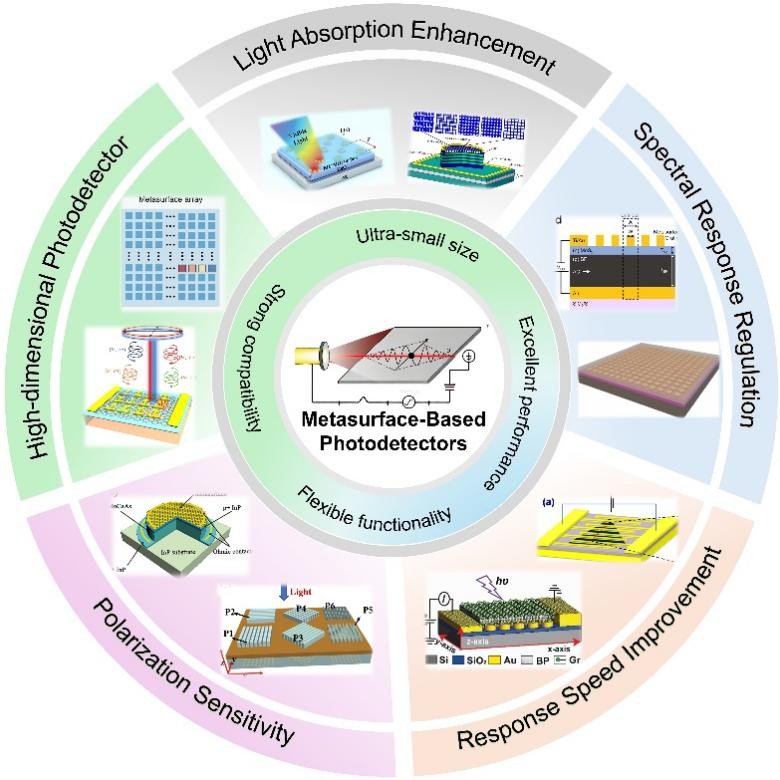
The research team at the Key Laboratory of Micro-Nano Optoelectronic Materials and Devices, Sichuan Normal University, has published a comprehensive review titled “Research Progress on Metasurface-Enhanced Photodetectors: A Review” in Volume 2 of the journal Opto-Electronics Plus on March 30, 2026. This review systematically summarizes the latest breakthroughs in integrating metasurfaces with photodetectors, focusing on five key performance dimensions.
First, the review details light absorption enhancement, where metasurfaces utilize resonance effects (such as Mie or plasmonic resonance) to boost absorption efficiency up to 99% in specific wavebands. Second, it covers spectral response regulation, demonstrating how metasurfaces can break material bandgap limits to achieve broadband or multi-band detection from UV to Terahertz. Third, response speed improvement is discussed, highlighting how localized fields accelerate carrier separation, reducing response times from milliseconds to microseconds. Fourth, the article explores polarization sensitivity, showing how chiral metasurfaces enable direct detection of circular and linear polarization without bulky external components. Finally, the review introduces high-dimensional photodetectors capable of simultaneously decoding multidimensional optical information (intensity, wavelength, polarization) using machine learning algorithms.
Section 3: Outlooks
Despite significant progress, challenges remain in translating these devices from lab to market. Key hurdles include the high precision required for nanofabrication (often needing electron beam lithography), compatibility with standard CMOS processes, and large-scale mass production. Future research should focus on developing low-cost batch fabrication techniques like nanoimprint lithography, improving wafer-scale uniformity, and designing efficient optical coupling interfaces for system-level integration. Overcoming these obstacles will unlock the full potential of metasurface photodetectors in real-world applications.
Section 4: Introduction to the Research Group
The Key Laboratory of Micro-Nano Optoelectronic Materials and Devices of Sichuan Province at Sichuan Normal University hosts a multidisciplinary team of 12 fixed researchers and more than 40 students, including 4 professors and 5 associate professors. The team focuses on condensed matter physics, optical engineering, and materials science. In recent years, the team has published more than 50 SCI papers in journals such as Nature Communications, Opto-Electronics Advances, and Acta Materialia. The laboratory maintains active collaborations with institutions including the Chinese Academy of Sciences and Germany’s Helmholtz Center Dresden-Rossendorf. The corresponding author Yijia Huang’s research interests include metasurface design, low-dimensional optoelectronic materials, and high-performance photodetector.
Reference
Title of original paper: Research progress on metasurface-enhanced photodetectors: a review
Journal: Opto-Electronics Plus
DOI: https://doi.org/10.67704/oep.2026.250021
Funding information
This work is supported by the National Natural Science Foundation of China (62105228) and the Opening Foundation of State Key Laboratory of Optical Technologies on Nano-Fabrication and Micro-Engineering.
Xiaoqing Liu
Opto-Electronics Plus
email us here
Legal Disclaimer:
EIN Presswire provides this news content “as is” without warranty of any kind. We do not accept any responsibility or liability
for the accuracy, content, images, videos, licenses, completeness, legality, or reliability of the information contained in this
article. If you have any complaints or copyright issues related to this article, kindly contact the author above.

Media gallery