Vadzo Imaging Positions Innova-234CGE: Onsemi AR0234 2MP Color Global Shutter GigE Camera for Reliable Day and Night Video Recording
The Innova-234CGE is a 2MP Color GigE Camera built on the Onsemi AR0234 sensor, and Vadzo is positioning it for
Press Release Disclaimer: This is a press release distributed through the XPR Media network. It has not been independently verified by our newsroom.


The Innova-234CGE is a 2MP Color GigE Camera built on the Onsemi AR0234 sensor, and Vadzo is positioning it for reliable day and night video recording. Recording that never stops asks more of a camera than a good picture. The stream must stay up for months, the bitrate must fit the network and the storage, the image must stay usable as daylight fades, and installation must be simple enough to repeat across many positions. As a 2MP Day Night GigE Camera and a 2MP Color Day Night GigE Camera, the Innova-234CGE answers those needs with a global shutter, an on-board ISP, ONVIF compliance, and PTP synchronization. It streams 1080p, 720p, and VGA at up to 60 frames per second, and it carries video, control, and power over a single Ethernet cable. Designed for smart surveillance, patient monitoring, and mobile robot systems, it gives integrators a color GigE camera that is built to keep recording.
IRVINE, CA / ACCESS Newswire / October 22, 2026 / Vadzo Imaging, a provider of embedded vision camera products for OEMs and system integrators, today positions the Innova-234CGE as a 2MP Color GigE Camera for reliable day and night video recording. Built on the Onsemi AR0234 sensor and part of Vadzo’s GigE camera portfolio, the Innova-234CGE combines a global shutter, an on-board ISP, ONVIF compliance, PTP synchronization, and Power over Ethernet in one module. With this positioning, Vadzo presents an AR0234 Color Global Shutter GigE Camera for smart surveillance, patient monitoring, and mobile robot applications, together with guidance on codec choice, bitrate planning, and day and night behavior for systems that must keep recording around the clock.
Why Dependability Matters in a 24/7 Video Recording GigE Camera
Round-the-clock recording is a reliability problem before it is an imaging problem. A camera that produces a beautiful frame for ten minutes has proved little. A camera that runs for a year at a doorway, a bedside, or a warehouse aisle has to keep its network link up, keep its bitrate inside what the network and the recorder can carry, and keep its image usable through every change in light. Failures in any of those areas show up late, often after the system is installed, and they are expensive to fix because the camera units are already mounted and wired. A dependable design avoids that second visit.
Bitrate is the most common surprise. Recording at 1080p and 60 frames per second produces a great deal of data, and a site with dozens of camera units multiplies it. Codec choice changes the numbers a great deal, and so does the way the encoder controls its rate. A constant bit rate keeps the load predictable and may soften busy scenes. A variable bit rate keeps quality steadier and lets the load swing. Teams that do not plan for this meet full disks and congested switches in the first month of operation, and they respond by cutting frame rate or quality after the fact. Planning bitrate before purchase is far cheaper than retrofitting storage.
Lighting is the second surprise. Sites that look bright at noon become dim at night, and a camera that exposes well in one state may struggle in the other. Automatic exposure and white balance must follow the change, and camera units that rely on infrared illumination at night must switch their optical path cleanly. A poor handoff at dusk creates a stretch of unusable footage exactly when security matters. Moving subjects add a third issue, since a rolling shutter bends vehicles and people who cross the frame, and the distortion makes review and analytics harder. A global shutter removes that source of error at the sensor.
Installation completes the picture. A camera that needs separate power, a separate data cable, and special tools for diagnosis adds cost and failure points to every position. Teams that discover these constraints after deployment must visit every site again. Choosing a camera that simplifies installation and diagnosis reduces that risk.
Innova-234CGE: AR0234 Global Shutter GigE Camera for Continuous Recording
The Innova-234CGE is built on the Onsemi AR0234, a 2MP (1920 x 1200) color global shutter sensor with a 1/2.6 inch optical format and 3.0 micron pixels. A global shutter exposes every pixel at the same instant, so passing vehicles, walking people, and moving robots keep their shape. The 3.0 micron pixels are large for a 2MP sensor and gather more light in dim scenes. The sensor pairs with an on-board image signal processor that performs debayering, demosaicing, color correction, contrast correction, gamma correction, denoising, and lens corrections, and supports automatic exposure and automatic white balance. The module outputs 10-bit video and encodes it inside the camera, which spares the recorder from handling raw frames. Encoding in the camera also keeps network traffic lower than raw video would.
The datasheet frame rates show how codec choice shapes a design. At 1080p, the module reaches 60 frames per second in H.264, 50 in H.265, and 40 in MJPEG. At 720p and VGA, it reaches 60 frames per second in all three formats. H.265 normally lowers bitrate for the same quality, so it saves storage, while H.264 offers the highest frame rate at 1080p. The right choice depends on what matters most, and Vadzo recommends recording a representative scene in each format and comparing the files. The encoder also offers constant bit rate, variable bit rate, and quality control, so teams can choose predictability or steadier quality, and plan their network and storage on that basis. Many teams run a short pilot with two or three positions to confirm the numbers before ordering for the whole site.
For day and night operation, the module supports an IR LED board and an IR cut filter control on specific variants. In auto mode, the filter switches between day and night modes based on lighting, and in manual mode, the user selects the mode through the web interface, along with IR brightness. The camera also supports automatic exposure and white balance, anti-flicker for 50Hz and 60Hz lighting, and manual control of gain and exposure. Because the transition at dusk is where footage is most likely to suffer, Vadzo recommends testing the switch across the real lighting curve of the site, and setting the thresholds so the camera does not toggle back and forth in marginal light. Recording a full evening, from late afternoon until well after dark, shows how the switch behaves in practice.
On the network side, the module uses a standard RJ45 connector and supports 100Base-T and 1000Base-T. It follows GigE Vision conventions and complies with ONVIF Profiles S for streaming, T for events, and G for recording, which lets standard video management software discover and use it. Power can arrive over PoE under IEEE 802.3af, in the range of 36 to 57 volts, so one cable carries data and power, and a status LED shows green on a gigabit link and orange on a 100 megabit link, which lets installers see at a glance how the camera negotiated. Power draw without the LED board is between 1.05 W and 1.75 W on PoE. The camera operates from minus 40 degrees C to 85 degrees C, measures 38 mm by 38 mm in a three-board build, and weighs 25 grams without the lens. Power over USB through a micro USB connector is also listed as an option, with a draw of 0.95 W to 1.9 W.
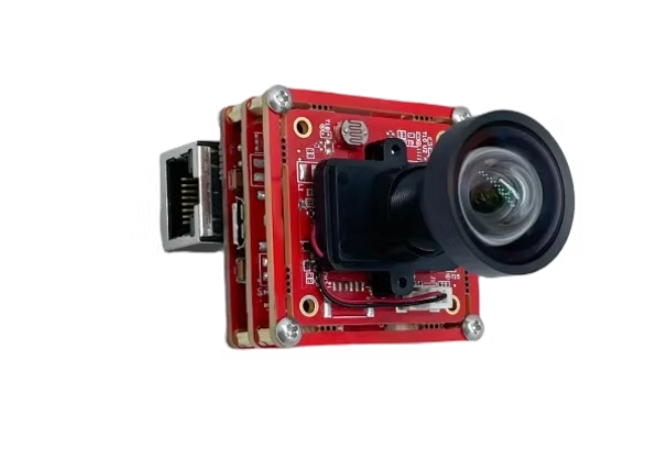
Product Overview
The Innova-234CGE is a 2MP color global shutter GigE module built on the Onsemi AR0234 sensor and positioned for reliable day and night video recording. As a 2MP Color Gigabit Ethernet Camera, it is built for integrators who need steady footage, controlled bitrate, and simple installation. The module combines the sensor, an on-board ISP, an H.264 and H.265 encoder, and a standard RJ45 interface with an S-Mount (M12) lens holder and a 105 DFOV lens. As a 2MP Day Night GigE Camera, it supports an IR LED board and IR cut filter control on specific variants for night operation. The 2MP Color Global Shutter Ethernet Camera designation confirms simultaneous exposure across the full frame, and the 24/7 Video Recording GigE Camera designation reflects the attention to bitrate, rate control, and operating range that continuous recording requires.
Key Specifications of the Onsemi AR0234 Global Shutter GigE Camera
Key specs: 2MP (1920 x 1200) Max Resolution | Onsemi AR0234 1/2.6 inch Sensor Format | 3.0 micron Pixel | Color with Global Shutter | GigE Interface (100Base-T and 1000Base-T) with PoE | S-Mount (M12 Standard) Optics with 105 DFOV Lens
1080p, 720p, and VGA at 60 Frames per Second in a 2MP Color GigE Camera
Smooth recording depends on frame rate as well as resolution, because fast subjects such as vehicles and moving people need enough frames to be followed clearly. As a color GigE module, the Innova-234CGE streams 1080p at 60 frames per second in H.264, 720p at 60, and VGA at 60, with the 1080p rate falling to 50 in H.265 and 40 in MJPEG. Teams can match the mode to the task, using 60 frames per second for fast-moving subjects and lower rates where storage matters more. A parking entrance may justify the highest rate, while a quiet corridor may not. Vadzo recommends verifying the chosen mode on the real network, since switches, cable quality, and recorder load all influence the result. Recording for a full day at the intended settings is the best check.
On-Board ISP with Auto Exposure and Auto White Balance
The on-board image signal processor finishes the picture inside the module. It performs debayering, demosaicing, color correction, contrast correction, gamma correction, denoising, and lens corrections, and it supports auto exposure and auto white balance. As a 2MP Color Day Night GigE Camera, the module therefore keeps brightness and color steady as daylight fades and as lamps come on. Manual control of gain, exposure, and white balance remains available for sites with controlled lighting, such as a warehouse aisle with fixed lamps, and anti-flicker settings for 50Hz and 60Hz help in rooms lit by fluorescent fixtures. Because the processing happens in the module, every unit in a deployment produces footage with the same look.
Rate Control and Codec Choice for Storage Planning
Storage is the quiet cost of continuous recording. The module encodes in H.264, H.265, and MJPEG and offers constant bit rate, variable bit rate, and quality control, so teams can choose between a predictable load and steadier quality. H.265 usually reduces the data volume for the same quality, while H.264 offers the highest frame rate at 1080p. A short trial that records the real scene in each setting gives integrators the numbers they need to size disks and switches before purchase. The same test also shows how the recorder behaves under the full load.
ONVIF Compliance with Profiles S, T, and G
The module complies with ONVIF Profile S for streaming, Profile T for events, and Profile G for recording. Standard video management and recording software can therefore discover the camera and request video, receive events, and manage recordings without custom code. This shortens commissioning in large sites, where installers expect a camera to appear in their software with little effort. Teams should confirm the specific ONVIF features they need against the module documentation, and they can test discovery and recording in their own video management software during evaluation. Operators who manage many sites also gain from a single discovery method across all their camera units.
PTP Synchronization for Aligned Recordings
When several camera units cover the same area, reviewers need recordings that line up in time. The Precision Time Protocol, defined in IEEE 1588, synchronizes camera clocks to a network time source so that frames from several units share a time base. This helps reviewers follow a person or vehicle across views and helps analytics combine them. PTP depends on a network that supports it, and Vadzo recommends testing the alignment on the real switches before a large rollout. A small pilot network is usually enough to reveal any issue before it affects many sites.
PoE, Link Status, and Operating Temperature
Power over Ethernet under IEEE 802.3af lets one cable carry video, control, and power, which removes a power supply and a cable from every position. A status LED shows green on a gigabit link and orange on a 100 megabit link, so installers can confirm the connection at a glance. The module operates from minus 40 degrees C to 85 degrees C, which covers most indoor and sheltered outdoor installations, and humidity is rated at 20 to 80 percent, non-condensing. As a Color GigE Camera Manufacturer, Vadzo supports lens matching, firmware customization, and enclosure design for volume programs. Teams moving from evaluation to production keep the same module, documentation, and behavior.
“People shopping for a recording camera often start with the picture, and then discover that the real work is keeping the system running. Bitrate has to fit the network, storage has to last, and the image has to hold up at dusk. The Innova-234CGE was positioned with those realities in mind. It encodes in the camera, offers constant and variable bit rate, carries power over the same cable, and uses a global shutter so moving subjects keep their shape. We encourage customers to record their own scene in each codec and to test the day and night switch on site, at the real mounting height and with the real lighting. A few days of testing at the start saves a great deal of effort later.” – Alwin Vincent, Product Manager, Vadzo Imaging.
GigE Camera Applications in Practice
Smart Surveillance Gigabit Ethernet Camera for Continuous Recording
Surveillance systems record without a break, so dependability and storage planning matter as much as image quality. The Innova-234CGE works as a Smart Surveillance Gigabit Ethernet Camera that streams over a single PoE cable and records with ONVIF-compatible software, and as a Day Night Surveillance GigE Camera, it supports IR illumination and filter control on specific variants for night footage. The datasheet lists facial recognition, day and night video recording, smart parking, and pedestrian safety as application areas, and its 2MP Smart Surveillance Camera role suits many of them. Teams should evaluate recognition performance on their own scenes. Fixed installations also gain from the datasheet temperature range when camera units sit outdoors in a sheltered housing.
Patient Monitoring GigE Camera for Bedside and Care Settings
Care settings run at all hours, and rooms are often dim at night. The module serves as a Patient Monitoring GigE Camera for bedside monitoring, fall detection and prevention, baby monitoring, and ICU monitoring, the application areas listed in its datasheet, and as a 2MP Patient Monitoring Camera, it can use infrared illumination so that night observation does not disturb patients. The camera supplies images only. Privacy, consent, data handling, and any clinical claims remain the responsibility of the solution provider and the care facility, and a wide 105 DFOV lens helps cover a whole room from one position. Fixed focus suits rooms where the bed and the camera stay in known places, and the lens can be changed if the layout calls for a narrower view. Facilities can also keep one camera type across wards, which simplifies spares and training.
GigE Camera for AGV and AMR Platforms
Mobile robots move through bright and dim areas and cannot stop to wait for a good exposure. The module works as a Mobile Robot GigE Camera for AGV, AMR, robotic arm, and drone platforms, with a global shutter that keeps edges straight during motion, and as a 2MP Day Night Mobile Robot Camera, it keeps working as lighting changes between warehouse zones and between shifts. A single Ethernet cable simplifies wiring on a moving platform, and the 25-gram module weight, without the lens, leaves room for the rest of the payload, and teams should check connector strain relief, cable routing, and vibration for their robot. Platforms that need a lighter wiring harness benefit from carrying data and power on the same cable.
Frequently Asked Questions
Q: How much storage does continuous camera recording need, and how can it be controlled?
A: Storage depends on resolution, frame rate, codec, and how busy the scene is, so there is no single number. Vadzo Imaging recommends recording a representative scene in each codec and measuring the file sizes, then multiplying by the number of camera positions and the retention period. A constant bit rate keeps the load predictable, while a variable bit rate keeps quality steadier. A 24/7 Video Recording GigE Camera that lets teams choose between them makes planning far easier, and a 2MP Day Night GigE Camera that encodes in the module keeps the recorder’s job simple.
Q: Is H.265 always better than H.264 for round-the-clock recording?
A: H.265 usually lowers the data volume for the same visual quality, which saves storage and bandwidth, but it is not always the better choice. Some modules reach a lower maximum frame rate at full resolution in H.265, and some recorders and players handle H.264 more widely. Vadzo Imaging suggests testing both formats with the real scene and the real recorder, and choosing on the basis of storage savings, frame rate needs, and software compatibility, since the best choice depends on the site.
Q: Can one Ethernet cable carry both video and power to a GigE camera?
A: Yes, when the camera supports Power over Ethernet, and the switch or injector supplies it. Under the IEEE 802.3af standard, a single cable delivers data and power, which removes the need for a power supply and a separate cable at each position. Vadzo Imaging recommends using certified Ethernet cables, checking the switch’s power budget for the total number of camera units, and confirming that the link negotiates at the speed the application needs, since a camera that falls back to a lower speed can drop frames.
Q: What should a care facility consider before using video for patient monitoring?
A: Start with privacy, consent, and the rules that apply to the facility and the region, because the camera supplies images and the solution provider and the facility remain responsible for how they are used. Then consider lighting, since rooms are often dim at night and infrared illumination can help without disturbing patients, along with coverage and data retention. Vadzo Imaging supports device makers with evaluation units and engineering guidance, and it makes no clinical claims for its camera modules; a Patient Monitoring GigE Camera is only one part of a larger system.
Q: What makes Vadzo Imaging a dependable Color GigE Camera Manufacturer for round-the-clock recording?
A: Vadzo Imaging offers more than a camera module built around a capable sensor. Integrators working with Vadzo Imaging receive a module with documented frame rates by codec, rate control options, ONVIF profiles, and a wide operating temperature range, along with candid guidance on bitrate planning and the limits of any day-and-night switch, plus engineering support for lens selection, firmware customization, and enclosure design. Vadzo Imaging maintains evaluation kits with no minimum order requirement, so teams can test on their own network before committing to volume production.
Availability
The Innova-234CGE 2MP Color GigE Camera built on the Onsemi AR0234 sensor is available now for evaluation and production orders. Evaluation kits include the camera module, S-Mount lens, and platform documentation, with no minimum order requirement. Integration teams can record their own scenes in each codec, test the day and night switch across their site’s lighting, and confirm PoE operation on their own switches before committing to a production bill of materials, which tells them more than a datasheet comparison alone. Teams that need a different lens or an IR LED board variant can ask Vadzo to review the configuration. Evaluation also lets teams check the link speed LED, the PoE budget, and the rate control settings that suit their storage plan, and confirm which ONVIF features their video management software uses. Browse the full range of GigE camera options at Vadzo’s website or contact Vadzo at support@vadzoimaging.com to request an evaluation unit or discuss OEM integration requirements for smart surveillance, patient monitoring, and mobile robot programs.
About Vadzo Imaging
Vadzo Imaging is a global provider of embedded vision solutions and delivers high-performance camera technologies and imaging platforms for applications in robotics, industrial automation, UAVs, edge AI, and medical systems. Its products are designed for seamless integration with leading embedded platforms. Vadzo supports customers through hardware customization, firmware development, and module-level drivers, enabling faster development and deployment of vision-based systems across GigE, USB, MIPI, Wi-Fi, and SerDes camera interfaces.
Media Contact
Alwin Vincent
Vadzo Imaging
Email: alwin@vadzoimaging.com
LinkedIn: Vadzo Imaging
YouTube: Vadzo Imaging
X: Vadzo Imaging
SOURCE: Vadzo Imaging
View the original press release on ACCESS Newswire
Media gallery