Every Megawatt of AI Capacity Can Make Up To 200,000 Gallons of Clean Water per Day
NEW YORK and ROHNERT PARK, Calif., Oct. 22, 2026
Press Release Disclaimer: This is a press release distributed through the XPR Media network. It has not been independently verified by our newsroom.

Every Megawatt of AI Capacity Can Make Up To 200,000 Gallons of Clean Water per Day
PR Newswire
NEW YORK and ROHNERT PARK, Calif., Oct. 22, 2026
Endeavour teams up with Trevi Systems to scale desalination technology driven by data center waste heat and advance zero-discharge solutions that produce clean water without the concentrated brines of conventional desalination plants.
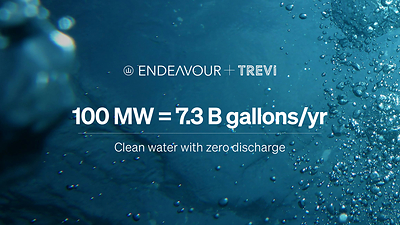
NEW YORK and ROHNERT PARK, Calif., Oct. 22, 2026 /PRNewswire/ — Endeavour and Trevi Systems today announced a strategic partnership to scale heat-driven desalination and brine concentration technology worldwide. Paired with waste heat from Endeavour’s ThermalWorks closed-loop waterless cooling platform, Trevi’s technology can turn a data center from a major consumer of water into a direct water producer. The systems can create up to 200,000 gallons (about 750,000 liters) of clean water a day from brackish groundwater for every megawatt of computing capacity, or about 50,000 gallons per day per MW from oilfield produced water.
Endeavour will first deploy the technology at its own U.S. data centers. Its global supply chain and gigawatt-scale manufacturing capabilities will support broader deployment with hyperscalers and data center operators worldwide.
Desalination plants provide essential freshwater to water-scarce regions, but they also produce large volumes of concentrated brine. For every liter of freshwater, a typical seawater desalination plant sends about a liter and a half of salty brine back to the sea. Eliminating the brine entirely has traditionally been too energy-intensive and expensive for widespread use. Trevi’s technology is designed to overcome that barrier, creating an opportunity to address water scarcity while reducing the environmental impact of desalination.
“Desalination can help address water scarcity, but managing the resulting brine remains a major challenge,” said Jakob Carnemark, founder and CEO of Endeavour. “Every day the world pumps more than a hundred million cubic meters of brine back into the sea. Trevi’s process runs on heat that is normally thrown away, and that changes the arithmetic. A network of data centers that make up to 200,000 gallons of clean water a day per megawatt could be the largest new source of fresh water on Earth. Our own data centers will be the first to prove it.”
“Forward osmosis was always the right physics for brine. What it lacked was well-matched heat at scale, and Endeavour has that,” said John Webley, founder and CEO of Trevi Systems. “Gigawatt-scale manufacturing, projects that reject heat around the clock, and a supply chain that reaches every water-stressed basin on Earth. We have run this process on seawater in Hawaii, on reverse osmosis brine in California and on produced water in California and soon Oman. Now we can build these plants by the hundreds.”
How it works.
The industry measures a data center’s thirst in liters of water consumed per kilowatt-hour of computing. A conventional evaporatively cooled facility runs at about 1.8 liters/kWh. Endeavour’s ThermalWorks group builds closed-loop, waterless cooling systems, so its data centers consume no water, and it captures the IT load’s heat at the temperature Trevi’s process needs. In Trevi’s forward osmosis system, water is naturally pulled through a membrane by a specialized draw solution, without the high pressure required for reverse osmosis, then the draw solution is regenerated with 60 to 80°C heat. The system removes the salt and contaminants while concentrating the brine to solids, powered almost entirely by waste heat. The result is clean water production of up to 31 liters/kWh of computing. A 100-megawatt campus can become a 20-million-gallon-a-day water plant whose energy is already paid for by the computing beside it.
The problem it solves.
One person in four, 2.1 billion people worldwide, still lacks safely managed drinking water, according to the UN World Water Development Report 2026. The world’s answer has been desalination, but the brine it leaves behind now totals about 140 million cubic meters a day worldwide, a volume expected to double by mid-century. Reverse osmosis brine is roughly twice as salty as the sea and often carries plant chemicals. It can sink to the bottom of the seabed, harm corals and kill seagrass.
Zero liquid discharge, which evaporates brine to solid salt, is the known fix. It has largely been priced out of municipal desalination because it typically runs on electricity. Conventional brine concentrators draw 16 to 26 kWh/m3 and crystallizers use 52 to 70. Trevi’s high-yield process pairs with heat-driven crystallizers that cut the purchased energy by roughly 85 percent.
Data centers used 415 terawatt-hours of electricity in 2024 and will use about 945 by 2030, according to the International Energy Agency. Put to work this way, the heat from the 2030 fleet could theoretically make more than half the 130 million cubic meters per day of clean water currently produced by every desalination plant on Earth.
Proven in the field.
Trevi has run its process on the waters that matter: a solar-thermal water plant at the Natural Energy Laboratory of Hawaii that made drinking water from seawater with no grid power, a two-year pilot with the Orange County Water District in California that concentrated reverse osmosis brine using waste heat, and oilfield produced-water systems in California and soon Oman. The company holds more than 65 patents in 21 countries.
Two founders who have scaled next-gen technology before.
Prior to founding Trevi in 2010 to commercialize forward osmosis, John Webley co-founded Advanced Fibre Communications, which reached a $6 billion market capitalization, and founded the optical networking company Turin Networks. Endeavour CEO Jakob Carnemark founded Aligned Energy before founding Endeavour in 2019 to develop and scale a new generation of sustainable data center technologies.
About Endeavour
Endeavour is a technology innovation company focused on redefining infrastructure for the age of AI. The company invents and invests in breakthrough technologies to make data center infrastructure faster and more agile while transforming it into a large-scale solution for climate change and water scarcity. These technologies work as an integrated system. The company’s Edged data center platform delivers the most efficient and scalable AI infrastructure in the industry. Its ThermalWorks cooling and TurboCell power platforms support AI growth while stabilizing the grid and conserving water. Its Voltek Water company builds modular, solar-integrated desalination, purification and atmospheric-water systems that deliver low-cost drinking water from brackish, contaminated and air-sourced water. Endeavour’s vision goes beyond minimizing harm: the company aims to build regenerative systems that restore local resources and generate global benefits. For more information, visit www.endeavourii.com.
About Trevi Systems
Trevi Systems, founded in 2010 and based in Rohnert Park, California, pioneered heat-driven forward osmosis desalination and brine concentration. Its systems use solar-thermal and waste heat rather than high-pressure pumping to produce clean water from seawater, brackish groundwater, produced water and industrial wastewater, and to concentrate brine for minimal and zero liquid discharge and mineral recovery, with pilot and commercial installations in the United States, Europe, the Middle East and Asia. trevisystems.com

 View original content to download multimedia:https://www.prnewswire.com/news-releases/every-megawatt-of-ai-capacity-can-make-up-to-200-000-gallons-of-clean-water-per-day-302916375.html
SOURCE Endeavour Energy, LLC