
30 Years Later: Family Businesses have Better Governance & Structure But Succession Conversations Still Need to Happen
The Family Business Consulting Group + Plante Moran study = education, comms, potential entitlement outpace competition
Press Release Disclaimer: This is a press release distributed through the XPR Media network. It has not been independently verified by our newsroom.

The Family Business Consulting Group + Plante Moran study = education, comms, potential entitlement outpace competition + labor costs among biz owners’ concerns
ROSEMONT, IL, UNITED STATES, October 14, 2026 /EINPresswire.com/ — The Family Business Consulting Group (FBCG), the leading authority in enabling family businesses to prosper across generations, and Plante Moran, a global accounting, tax, consulting and wealth management firm, today revealed the results of a 30-year study that benchmarks current family businesses against landmark survey data from 1995 and 1997 to identify what has changed, what has improved, and what remains unresolved.
Thirty years ago, family business owners were most concerned about competition, regulation and labor. Today, their concerns increasingly center on preparing the family for the future. Education of family members and concerns about preventing a sense of entitlement were the two most frequently cited challenges to the future growth and survival of family-owned businesses, at 49% and 44%, respectively. Labor costs at 41%, and increasing competition, at 39%, remain significant concerns but no longer top the list.
The contrast with 1995 is striking; at that time, respondents cited increasing competition (47%), regulatory burdens (40%), labor costs (30%) and a lack of qualified workers (29%) as their leading challenges. Slightly more than one-quarter included business succession planning among their top three concerns.
Family education and entitlement were not response options in the 1995 survey, FBCG and Plante Moran added them to the 2025 questionnaire based on anecdotal evidence as they become increasingly common observations in their work with family enterprises. Respondents subsequently ranked those two family-related issues first and second.
Importantly, the survey measures owners’ concern about entitlement, not evidence that rising-generation family members are more entitled than previous generations. Entitlement usually signals unclear expectations rather than character. That distinction matters. Families responding to the survey also report using practices that can help address the concern, including family education, employment policies and market-based compensation.
“The question for family businesses is no longer only, ‘Can the business withstand external pressures?’ It is increasingly, ‘Are we preparing the family to own this responsibly and with purpose?’” said Kristi Daeda, President and CEO of The Family Business Consulting Group. “Preparation for the next generation doesn’t happen without coordination and planning. Education, clear expectations and meaningful responsibility are how families build engaged stewards over time. Communication is the key to all of those elements.”
The findings reflect a shift in how many family enterprises think about long-term risk. External pressures have not disappeared. Competition, labor costs and economic uncertainty remain part of running any business. But today, family owners are also asking whether future generations will understand what they own, what will be expected of them and how they can contribute responsibly.
Conversations about succession and continuity, in addition to preparing the next generation to operate a business, may need to start earlier than families expect. Younger family members can encounter information about a family business or family wealth through classmates, colleagues, social media or online searches well before parents have decided how to address those subjects at home. That creates an opportunity for families to make education intentional and age-appropriate rather than waiting for an ownership transfer or leadership transition.
Education can include the history and values behind the enterprise, how the business creates value, what ownership means, expectations for family employment, financial literacy, governance and the responsibilities that accompany opportunity. As family members mature, those conversations can become more sophisticated and provide meaningful ways to participate without assuming that every family member will work in the business or hold a leadership role.
“The goal is not to guarantee every family member a role or a voice in every decision,” Daeda said. “It is to help people understand what they are part of, what responsible ownership asks of them and how they can prepare to contribute. Engagement and accountability need to develop together.”
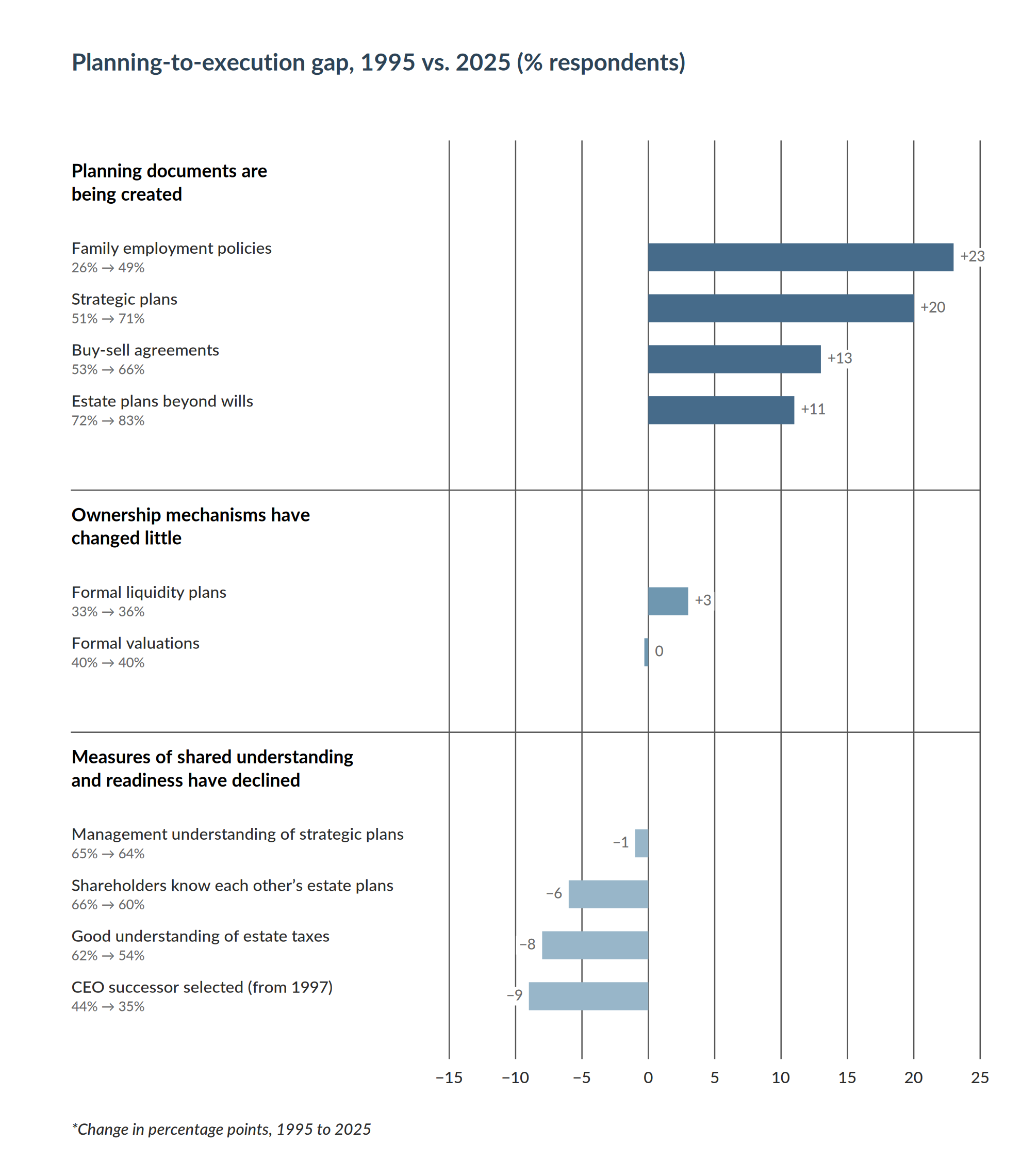
The findings also put the study’s succession data in a broader context. Family businesses have become more formal in many areas of governance and planning, yet fewer families have named a successor today: 44% in 1997 compared with 35% in 2025. The gap suggests that stronger structures alone do not resolve the human decisions at the heart of continuity.
“For decades, families have become more sophisticated about the financial structures that support succession. What this study makes clear is that continuity also depends on preparing people through education, communication and clear expectations about ownership,” said Jeff Watkins, partner, Plante Moran. “The strongest transition plans connect the financial side of succession with the family’s readiness for it.”
For FBCG, governance is not simply a board, policy or estate plan. It is the system a family uses to create clarity, make decisions, establish expectations and stay aligned as ownership and leadership evolve. Plante Moran brings a complementary financial and technical perspective, helping enterprising families address the tax, estate, valuation, liquidity and ownership structures that support transition.
Despite these challenges, family business owners remain optimistic about the future. Ninety-five percent expect revenue growth over the next five years, and the same percentage expect their businesses to remain under family control during that period.
Taken together, the findings suggest that family owners remain committed to continuity but increasingly understand that sustaining it requires more than preparing the enterprise. It also requires preparing the people who will one day own, govern and lead it.
About the Family Business Consulting Group
The Family Business Consulting Group (FBCG) is the leading advisory firm dedicated exclusively to serving family enterprises. With a team of highly credentialed practitioners, FBCG helps families navigate the complex nature of ownership, leadership, and family dynamics to build legacies that endure.
About Plante Moran
Plante Moran is a global accounting, tax, consulting and wealth management firm, provides a full line of services to organizations in manufacturing and distribution, service, health care, private equity, public sector, financial services, real estate, construction and energy. Throughout its more than 100 years in business, the firm has grown to a staff of more than 4,500 professionals throughout the United States and internationally. Plante Moran has been recognized by a number of organizations, including by Fortune magazine, as one of the best places to work in America.
Philip Robertson
Impact Partners PR LLC
Visit us on social media:
LinkedIn
Legal Disclaimer:
EIN Presswire provides this news content “as is” without warranty of any kind. We do not accept any responsibility or liability
for the accuracy, content, images, videos, licenses, completeness, legality, or reliability of the information contained in this
article. If you have any complaints or copyright issues related to this article, kindly contact the author above.

Media gallery
