eLeaP QMS Positions Regulated Manufacturers Ahead of the ISO 9001:2026 Transition
As ISO 9001:2026 nears publication, eLeaP QMS offers a built-in gap analysis toolkit to help organizations prepare for
Press Release Disclaimer: This is a press release distributed through the XPR Media network. It has not been independently verified by our newsroom.
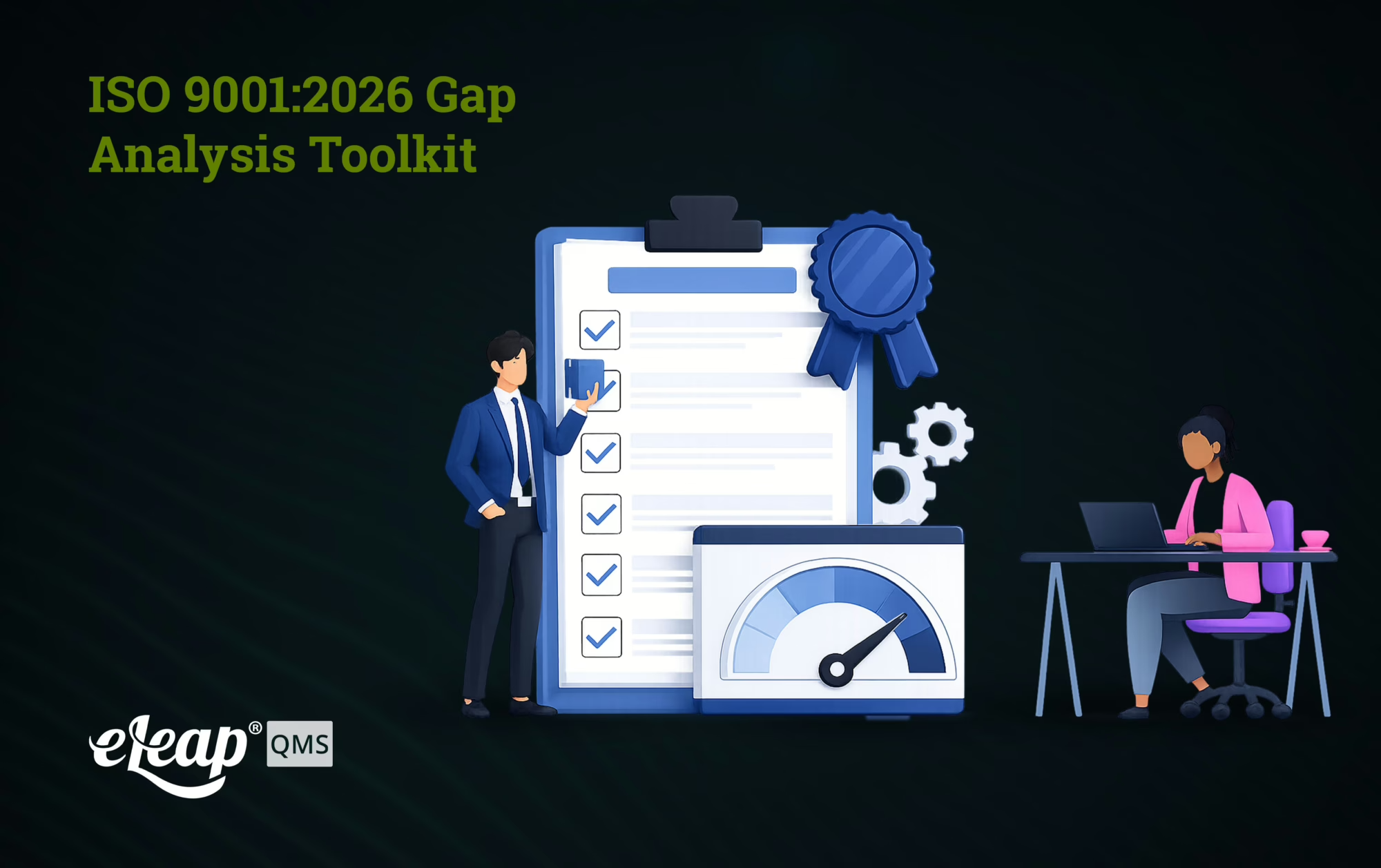

As ISO 9001:2026 nears publication, eLeaP QMS offers a built-in gap analysis toolkit to help organizations prepare for the revised standard.
LOUISVILLE, KY, UNITED STATES, August 31, 2026 /EINPresswire.com/ — eLeaP, a quality management software provider for regulated industries, announced its readiness for ISO 9001:2026, the upcoming revision to the world’s most widely adopted quality management standard, and released a free ISO 9001:2026 Gap Analysis Toolkit to help organizations identify where their current quality management system falls short of the new requirements before their next audit.
ISO 9001:2026 is set to publish in September 2026, and quality teams across manufacturing, medical device, pharmaceutical, and other regulated sectors are beginning to assess what the revision will mean for their existing documentation, processes, and certification timelines. Organizations that wait until publication to begin their gap analysis risk falling behind on remediation before transition deadlines arrive.
The draft standard makes targeted updates in five areas: climate-relevance documentation (Clause 4.1), ethical-leadership and employee awareness requirements (Clauses 5.1 and 7.3), separate risk and opportunity evaluation criteria (Clause 6.1), post-implementation verification for QMS changes (Clause 6.3), and proactive customer communication during disruptions (Clause 8.2). Everything else — the process approach, risk-based thinking, the Plan-Do-Check-Act cycle, and the Annex SL structure — stays the same. Because the standard remains in Final Draft International Standard status, exact clause numbering may still shift before formal publication.
Three of the five updates — Clauses 5.1, 6.3, and 7.3 — generate evidence that lives in the training record rather than the quality-event record, a distinction that maps directly onto eLeaP’s integrated QMS+LMS architecture.
“Every ISO revision creates the same problem: teams don’t know what’s actually changed until they’re deep into a gap analysis, and by then they’re already behind,” said Don Weobong, President at eLeaP. “We wanted customers and prospective customers to have a clear, practical starting point the moment the standard was finalized, not weeks after. The toolkit gives quality leaders a way to see exactly where their current system stands relative to the new requirements.”
The toolkit is organized in three parts. A 30-row gap analysis checklist walks through all five clause areas, with a four-option compliance status for each requirement — Compliant, Partial, Gap, or N/A — plus fields for evidence references and notes. An action planning register carries every identified gap forward with an assigned owner, target date, and priority level. An executive summary is designed to stand alone as a readiness report, complete with a gap count by clause area and an overall readiness rating, for a certification body or leadership audience that doesn’t need the full checklist detail.
eLeaP QMS is built to support the ISO 9001 quality management system, which is core to nearly every regulated organization, connecting document control, design & development, risk management, change control, CAPA, supplier management, and event management into a single platform, with training automatically deployed as each process changes. Because the platform already unifies these processes rather than treating them as separate modules bolted together, organizations using eLeaP are positioned to adapt to ISO 9001:2026’s updated requirements without re-architecting their quality system.
The platform’s QMS+LMS integration extends across eLeaP’s full regulated-industry footprint, from medical device manufacturers operating under the FDA’s Quality Management System Regulation (QMSR) to pharmaceutical and life sciences organizations managing ICH-aligned quality systems. Each vertical faces its own documentation and audit-evidence requirements, but the underlying gap — quality processes and training records living in separate systems — is the same one ISO 9001:2026 puts additional pressure on.
eLeaP serves ISO 9001-certified organizations across manufacturing, medical device, pharmaceutical, biotechnology, aerospace, automotive, and food & beverage industries, and supports complementary standards, including ISO 13485, AS9100, and IATF 16949, within the same platform.
Availability
The ISO 9001:2026 Gap Analysis Toolkit is available now, free of charge. Organizations interested in a live platform walkthrough can request a free demo.
About eLeaP
eLeaP is a comprehensive quality management system with enterprise learning management built into one unified platform, purpose-built for regulated industries including medical devices, pharmaceuticals, biotechnology, aerospace, automotive, and food & beverage. Unlike standalone QMS solutions, eLeaP automatically connects quality processes — documents, design & development, risk, change, events, and suppliers — to training verification, closing the compliance gap that exists when QMS and training records live apart. With 20 years of experience serving more than 1,200 regulated companies, eLeaP helps organizations achieve faster regulatory submissions and maintain continuous audit readiness. Learn more at https://quality.eleapsoftware.com .
Mayra Veras
eLeaP
+1 877-624-7226
email us here
Visit us on social media:
LinkedIn
Instagram
Facebook
YouTube
X
Five Compliance Gaps in ISO 9001:2026 — How to Close Them in Three Years
Legal Disclaimer:
EIN Presswire provides this news content “as is” without warranty of any kind. We do not accept any responsibility or liability
for the accuracy, content, images, videos, licenses, completeness, legality, or reliability of the information contained in this
article. If you have any complaints or copyright issues related to this article, kindly contact the author above.

Media gallery